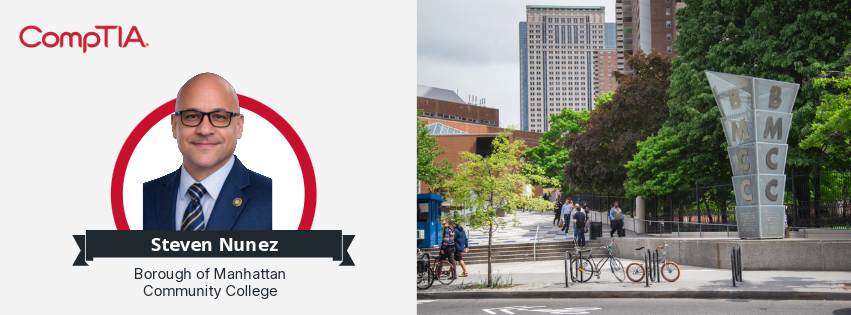
Borough of Manhattan Community College (BMCC) in New York faced a familiar problem: adult learners with strong technical ability working below their skill level due to language barriers and a lack of industry-recognized credentials.
Instead of accepting that loss, Steven Nunez, Director, Office of Apprenticeships & Department of IT Training Programs, launched an ESL-focused IT pathway that integrates English language learning with CompTIA A+ certification training for non-English speaking students from around the world who have a passion for learning tech.
Each cohort of 15-20 learners receives hands-on technical instruction, focused English support, and career preparation. Many graduates move directly into IT roles, often starting on BMCC’s own service desk and instructional support teams.
Over time, this has become a framework that other institutions can adapt to help move their English language learners into IT careers.
Who the program serves and why that matters
The BMCC ESL A+ pathway serves a clear learner profile: adults with basic technical skills but limited English. Some have worked in computer repair or technology-related roles, while others were engineers or IT professionals in their home countries.
Their barrier is not ability, but access. English-heavy textbooks, exams, job postings, and interviews keep them out of IT roles. BMCC deliberately treats these adult learners as overlooked talent, not remedial learners. When the language load is managed and instruction is contextualized, they succeed in CompTIA A+ and beyond. That shift from “deficit” to “potential” drove the program’s design.
At BMCC, CompTIA A+ also provides college credit. It functions both as an entry-level IT credential and a stackable component within degree and certificate programs. Students who want to advance can build on A+ with CompTIA Network+ and other IT pathways aligned to BMCC’s academic offerings.
How BMCC integrates ESL, A+, and career readiness
Students meet three days per week, six hours per day. One day is dedicated to English, focused on technology vocabulary and workplace communication. The other two days focus on CompTIA A+ content. Instruction is co-delivered with BMCC’s Literacy Department, following an I-BEST (Integrated Basic Education and Skills Training) model, so language and technical skills are taught together rather than in separate classes.
The Literacy Department also co-leads recruitment and screening, including a brief computer skills assessment. In one cohort, roughly 30 applicants were narrowed to 18 students. Selection is based on basic technical aptitude and readiness for an intensive program, not polished English. This approach uncovers potential that traditional admissions processes may miss.
CompTIA A+ is the program’s technical anchor and primary entry point into IT. Around that anchor, BMCC integrates resume-writing support, career workshops, and soft skills training informed by the NACE (National Association of Colleges and Employers) competency model. These elements are not merely add-ons: troubleshooting labs double as communication practice, and ticket-writing exercises build both technical precision and written English.
Employment is built into the design. BMCC partners with a job development team and external employers, but the college itself is the largest hirer of graduates, especially into service desk and instructional tech support roles. Apprenticeship options and additional certifications, such as CompTIA Network+, give learners a solid pathway to follow beyond that first role.
Nunez believes celebration is a vital part of the program. Each cohort concludes with a completion ceremony that includes family and friends. For many immigrant and first-generation learners, it is a rare public acknowledgment that their new skills are recognized and portable. It also serves a pragmatic purpose: visible success stories strengthen recruitment and reinforce the message that these students are an institutional and community asset.
Outcomes, hiring impact, and credential strategy
BMCC’s results show a durable model for moving English language learners into IT roles. The second cohort achieved 100% CompTIA A+ certification, an unusually strong outcome for students who typically face additional exam barriers due to language.
Since 2015, BMCC has expanded from standalone computer repair courses to a broader tech stack that now includes A+ and Network+. That evolution reflects a sustained institutional commitment to these learners.
The college has also tied the pathway closely to its own hiring needs. Many graduates move into service desk and tech support roles at BMCC, so the program is calibrated against real operational requirements rather than abstract job descriptions. This feedback loop helps the team refine content and pacing based on how graduates perform on the job, not just the exam.
On the credential side, Nunez is direct. He calls CompTIA “the best organization to help people enter the IT field” and describes A+ as “the foundation that allows learners to go anywhere in the world.”
That conviction shapes the program: A+ is the core credential, with additional certifications and experiences built on top, rather than a loose mix of unrelated courses.
How institutions can put these lessons to work
For other institutions, the value lies less in BMCC’s exact schedule and more in the underlying logic. Effective pathways are designed around the full learner lifecycle:
- Who you recruit and how you screen: identify “untapped talent” with technical aptitude but language barriers, and select for potential, not polished English
- What learners experience in class and lab: integrate language support, certification prep, and career readiness instead of offering them in separate silos
- Where they land next: define clear entry-level roles, apprenticeships, or further study opportunities so the pathway leads to a concrete outcome
BMCC’s experience also cautions against a “one and done” mindset for certification. A standalone A+ course rarely changes outcomes on its own. Treat A+ as a first step in a pathway that can include Network+, apprenticeships, and other academic progression. A visible trajectory makes the investment more compelling for both learners and institutional leaders.
Build employability skills into the core of instruction, not as optional workshops. BMCC has found it beneficial to incorporate career readiness, panel discussions and site visits to IT partners to enhance the total experience. Resume writing, interview preparation, and NACE-style career competencies should be threaded through labs and troubleshooting scenarios so learners practice workplace communication, teamwork, and professionalism while mastering technical content.
Finally, treat your certification vendor as a strategic partner, not just an exam provider. By leveraging CompTIA job reports, instructional materials, and direct support, institutions can avoid rebuilding content from scratch and add credibility to their local programs. An active partnership gives you access to labor market data, curriculum resources, and external validation that are difficult to replicate alone.
Moving from insight to action
If you oversee IT training, adult education, or workforce programs, the most actionable starting point is a clear audit of what you already offer. Put your ESL offerings, IT courses, and career services side by side and look for quiet barriers, such as:
- language-heavy prerequisites that screen out capable learners.
- standalone IT classes with no clear employer connection.
- resume workshops or coaching with no defined pathway attached.
Those seams reveal where an integrated pathway could create immediate value.
From there, design a single integrated pilot to close at least one of those gaps for a clearly defined learner group. Identify your own “untapped talent” population and select a foundational credential with clear market demand, such as CompTIA A+. Bring in a language or foundational-skills partner as a true co-owner, and jointly map a complete learner lifecycle from recruitment to the first role.
Keep the initial cohort small enough to support closely but large enough to learn from, and track four basic metrics over time: who starts, who finishes, who certifies, and who is hired.
BMCC’s experience suggests that the constraint is rarely talent. The real constraint is whether institutions are willing to design around that talent to align language support, certification, and career readiness as solutions to the same problem.
If you want to explore CompTIA-powered IT pathways, contact us to discuss your goals, learner population, and local labor market needs. Together, we can help you design a program grounded in the same practical, outcomes-focused approach BMCC has used.