Corporate AI Adoption

Summary

One of the great challenges in technology this century has been bridging the gap between consumer tools and corporate systems. Where the consumer side was once a trickle-down effect from technology developed for businesses who could afford the cutting edge, it is now often the place where innovation first appears. The challenge, then, is adding the layers of security, reliability, and functionality needed by the corporate market.

AI is caught directly in this dilemma today. The speculation around AI’s impact on business has been largely driven by usage patterns and cost structures at the individual level, and scaling all the way to enterprise levels is proving many of those assumptions to be faulty at best. Even though generative AI has been on the market for nearly four years, corporate adoption is still in very early stages. Even at this point, cracks in the strategy are beginning to appear—such as the gap between executive expectation and implementation capability, or the willingness to invest versus the readiness to build policy around such a disruptive trend.

CompTIA’s Corporate AI Adoption study examines the state of AI strategies, as businesses are seeking a balance between individual employee enablement and fully integrated workflows. The research uncovers the way AI is fitting into overall technology strategy, the challenges that need to be overcome, and the key factors that will lead to future success.

Key takeaways

レポートをダウンロード

AI Skills Tracker (英語/PDF)

CompTIA AI Skills Tracker Research Report cover showing a smiling man looking at a tablet.


Early AI adoption highlights the critical connection between technology and business

  • 59%

    Working to integrate AI into their overall technology stack

  • 67%

    View technology teams as the primary owners of AI execution

  • 79%

    Plan to increase AI investment in the next 12 months

Building momentum requires overcoming behavioral and technical hurdles

  • 56%

    See the workforce as cautious or reluctant regarding AI

  • #1

    Rank of finding human/AI balance as an adoption challenge

  • 57%

    Plan to build new training programs addressing the full range of skills including AI

Future success hinges on data, policy, and tech operations

  • 78%

    See room for improvement in use of data

  • 66%

    Rate responsible AI usage as very important when creating AI policy

  • 93%

    Expect technology teams to play a steady or growing role as AI is adopted

1. Early AI adoption highlights the critical connection between technology and business

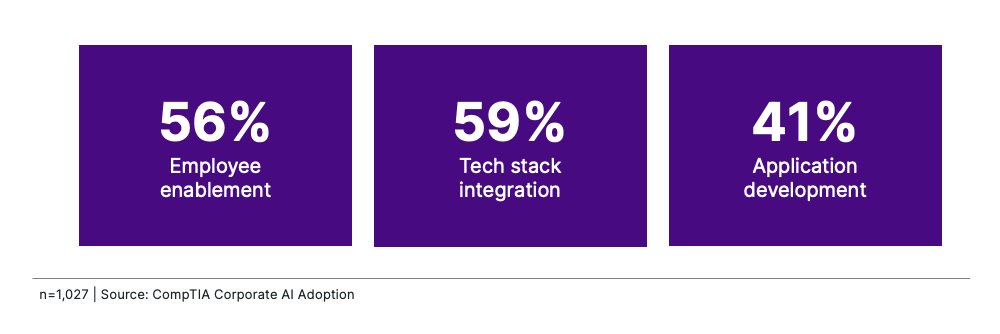
  • AI adoption has three modes: employee enablement, tech stack integration, and application development
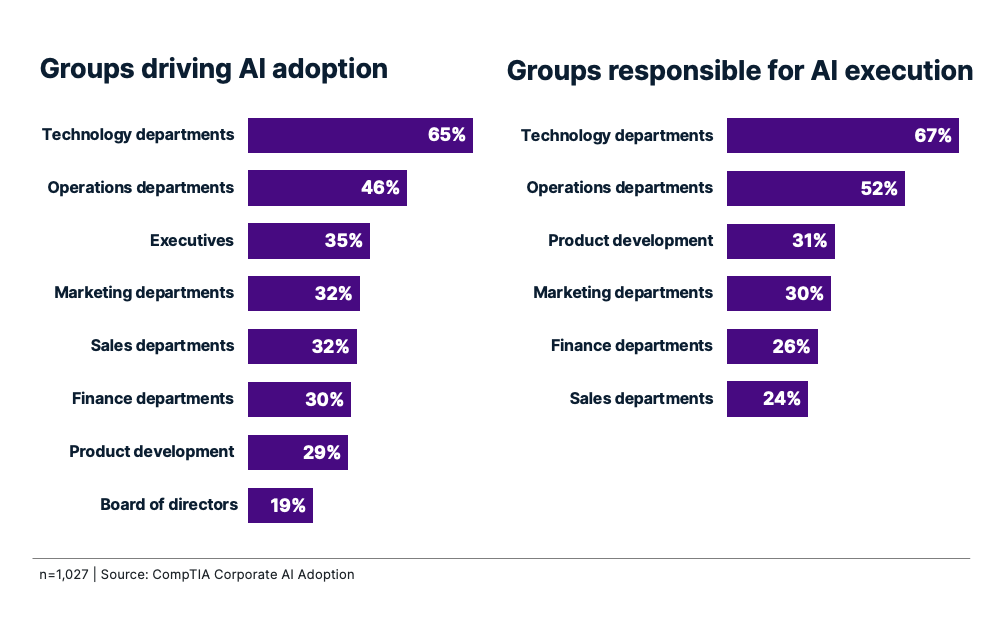
  • The technology team is often seen as the driver for AI adoption, though this is likely due to their role as the group responsible for execution
  • Nearly 8 in 10 companies expect increases in AI investment, focused on training, cybersecurity, and data


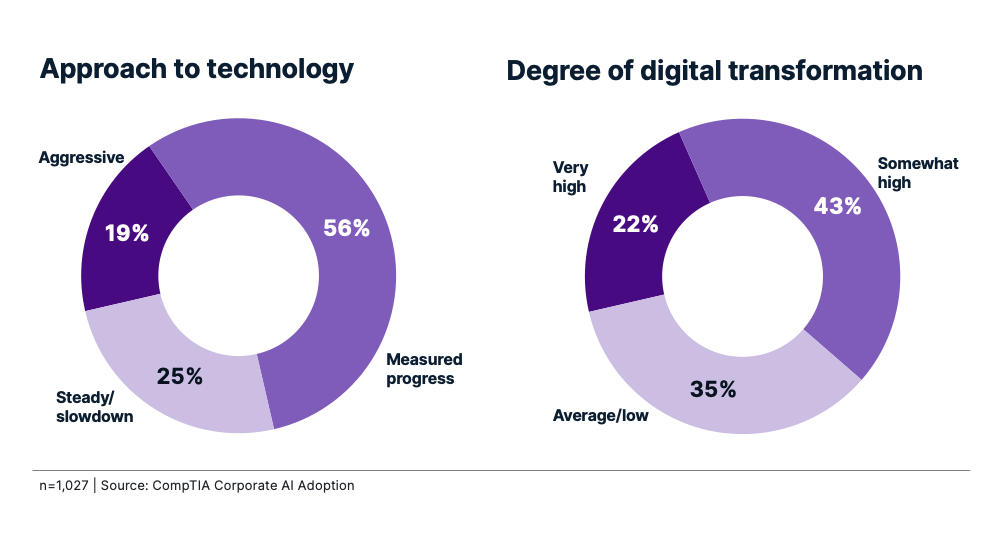
The first step in understanding the current state of AI adoption is to recognize that AI does not exist in a vacuum. Instead, AI is part of an organization’s overall technology architecture, and the approach to AI will largely be dictated by the approach to technology and the drive for digital transformation. 

A company’s approach to technology captures organizational attitudes around setting budgets, evaluating new trends, and developing the appropriate skills. The degree of digital transformation acts as a signal for the current state of architecture and the previous trends that have been incorporated. Based on previous CompTIA research, there has not been a significant shift in technology approach, nor are companies operating with a highly stable foundation for building AI capability.


Approach_to_technology_Degree_of_digital_transformation.png


As expected, those companies taking an aggressive approach to technology are the furthest ahead with digital transformation--58% of firms with an aggressive approach claim a very high degree of transformation, compared to 16% of firms making measured progress and 10% of firms taking a steady approach or a slowdown. 

There is a similar breakdown when it comes to AI adoption, but not for every mode of adoption. Integrating AI into an overall technology stack or building internal applications with AI both occur more frequently among companies with an aggressive approach, but employee enablement for chat tools is relatively constant across all technology approaches. This distinction highlights the different priorities and assumptions around ease of implementation that may be getting applied to the catch-all term of “AI adoption.”

CompTIA Corporate AI Adoption statistics: 56% employee enablement, 59% tech stack integration, and 41% application development.

To understand exactly what is meant by AI adoption, it is important to understand the distinctions between the groups driving adoption versus those executing the details. While the majority of the sample sees technology teams driving adoption, this is driven by views of those close to daily details in IT and business functions. More than 6 in 10 respondents in executive roles view the executive team as a driver of AI adoption. Executives, focused on overall objectives, may be pushing for AI adoption in a general sense – e.g., to ensure that the company is taking advantage of the technology and not getting left behind – rather than driving adoption in a technical sense.

There is consensus, though, around the technology team being responsible for execution, and since this is the point where implementation details are communicated to the workforce, that may drive the view that technology departments are actually the drivers of adoption. The nuance here is important. The purpose of AI adoption is not simply to be on the cutting edge of technology; it is to make the business more productive and efficient. Making this connection has become a more important part of strategic IT, and the task is complicated further when attempting to incorporate a consumer-based individual tool securely into an organization at scale. 

Bar charts showing technology and operations departments leading in both driving AI adoption and executing AI initiatives.

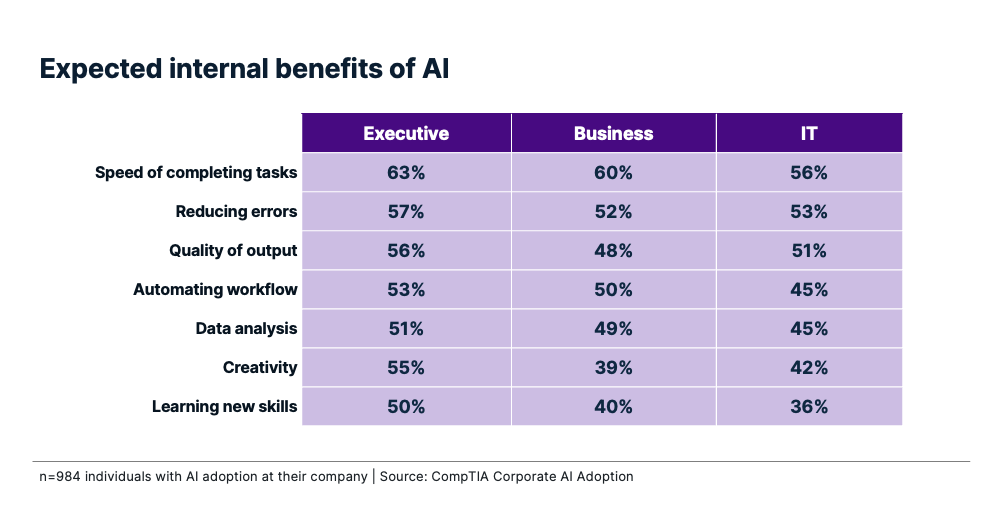
Two primary themes emerge when evaluating the benefits companies expect to realize with AI. First, the expectations around what AI will deliver are built on an assumption of strong institutional or job role-related knowledge. By a relatively wide margin, the top expected benefit is the speed of completing work tasks. On its own though, this says nothing about the validity of those tasks. Along the same line, improved quality of output ranks third on the list, but this implies either that AI training has a high degree of accuracy or that the individuals using AI are able to discern between high and low quality.

Table showing expected internal benefits of AI across Executive, Business, and IT roles, led by speed of completing tasks.

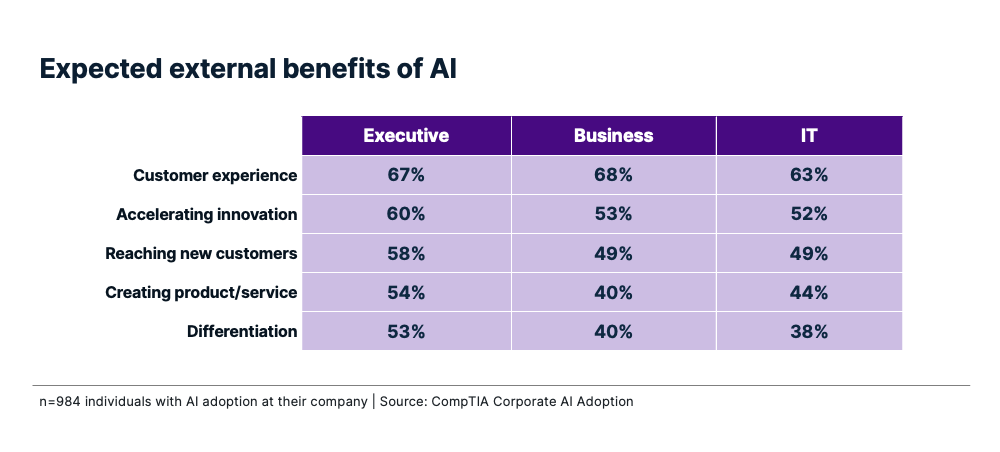
The second insight from expected benefits is that executives consistently take a more positive view of what AI can accomplish compared to either those individuals in a business role or those in an IT role. This is especially true regarding AI’s ability to extend beyond established workflow, such as creative ideas, the development of new skills, or the promise of reaching new customers. The viewpoints at the executive level—which factor significantly into media narratives around AI’s possibilities—are tempered by those doing the most work with the tools to enhance existing processes.

Table showing expected external benefits of AI across Executive, Business, and IT roles, with Customer Experience scoring highest (67%, 68%, 63%).

Taken together, these expectations paint a familiar picture, where emerging technology has impressive capabilities in theory but often struggles to reach full potential at scale. For AI to extend beyond transformative capability at an individual level, there will need to be corporate decisions and tactics around cybersecurity, policy, workflow, and training.

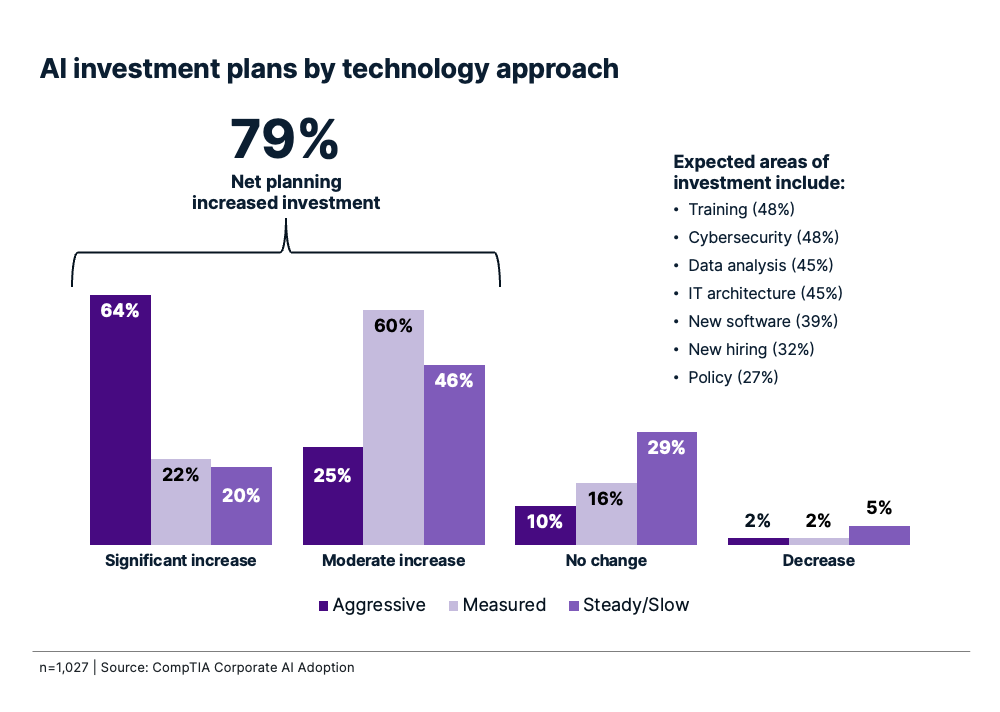
Another familiar part of emerging technology is early enthusiasm around investment. AI is no exception to this trend, with nearly 8 in 10 businesses expecting to increase their AI investment in the next 12 months. As expected, those companies taking an aggressive approach to technology are also taking an aggressive approach to investment, but there are still a significant number of companies with a more moderate technology approach planning to increase investments.

The areas where increased spending is expected act as a signal for both organizational priorities and future skill demands. Until recently, employee enablement has been the primary mode of AI adoption, with training focused on basic concepts and best practices in interaction. Now that companies’ focus is shifting to integration within the tech stack and workflow, training is beginning to explore deeper needs around AI fluency, and other disciplines are coming into the picture.

The intersection of AI and cybersecurity has been one of the most relevant aspects of AI adoption, as AI accelerates both the capabilities of security operations and the scale of threat vectors. Organizations not only need to build skills among their cybersecurity specialists, but also need to consider the impacts for cybersecurity awareness across the workforce.

The anticipated investment in data analysis is likely to drive further workforce development efforts as well, since many companies are expecting a growing number of their non-technical job roles to be conversant with some form of data analysis. Of course, there is also a growing cadre of data specialists who manage data, perform advanced analytics, and provide an abstracted structure enabling broad workforce data access.

Chart of AI investment plans by tech approach; 79% plan increased investment, with training and cybersecurity as top areas.

The intense focus on cybersecurity and data has diminished the conversation around IT architecture, but there are clearly major changes taking place as businesses evaluate options for models, data storage, and endpoint devices. As the costs of AI rise, there will be a return to the public/private/hybrid debate that also defined cloud adoption.

Finally, it is worth pointing out the low expectations around investment in AI policy. Policy, whether defined as internal operational models or external compliance to regulations, has become the latest aspect of technology adoption to be undervalued. The disruptive potential of AI is not just a problem for the IT team to solve; the entire business must get aligned around new workflows, best human/tool balances, and adherence to technical regulations. Clear AI policies should be part of that process, but as these findings indicate, most companies are not prioritizing AI policy development in their investment planning.


2. Building momentum requires overcoming behavioral and technical hurdles

  • Changing employee behavior is likely a greater challenge than solving technical issues
  • Skill gaps are a key element of adoption challenges, ranging from AI fundamentals to implementation skills and also including gaps in existing core domains.
  • Adoption and skill-building go hand in hand, with enterprise adoption driving specific skills that should be addressed in holistic training programs


Technology adoption tends to focus on the technical challenges. What is the cost/benefit analysis? How will the technology be integrated with existing systems? What is the rollout and support plan for end users? These questions are all valid, but employee behavior is often the primary hurdle to clear. That is certainly true in the case of AI.

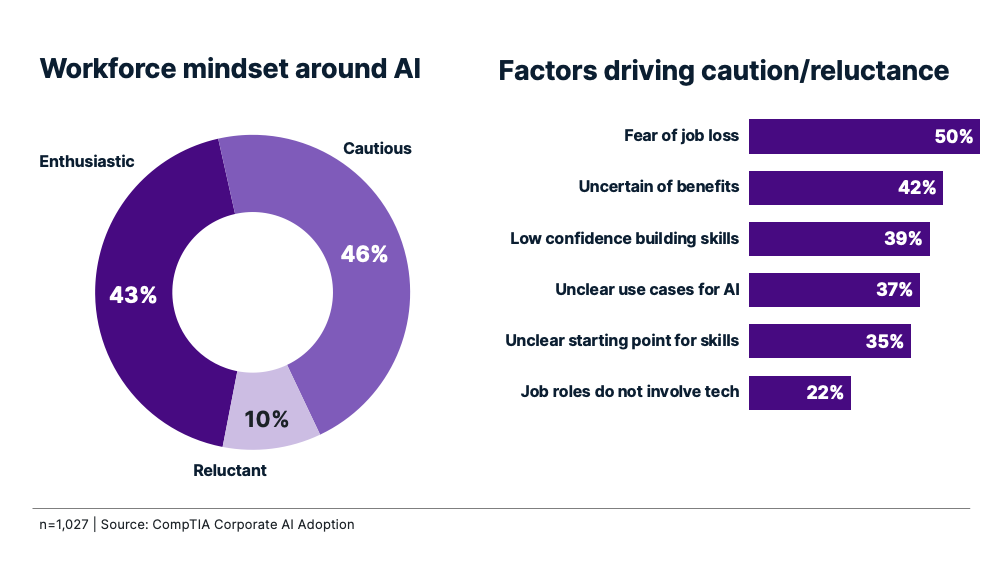
For smaller technology implementations, a company may choose to deprecate an old system to force new behavior or accept a longer transition curve. For something as prominent as AI, the list of considerations becomes more complicated. The Americans and AI 2026 study from the Pew Research Center found that 40% of U.S. adults believe AI will have a negative impact on society, compared to only 16% expecting a positive impact (the remainder expected a neutral impact or were unsure). Employers see this sentiment reflected in their workforce: only 43% of CompTIA’s sample believes their workforce is enthusiastic about AI adoption.

Infographics showing workforce AI mindsets (46% cautious, 43% enthusiastic) and main concerns like fear of job loss (50%).

Speculation about job losses is the top factor driving lower sentiment in CompTIA’s study, and that is unlikely to be a factor that companies take on directly. The other factors, though, are more addressable. To the extent employees are not concerned about job loss, they may be confident in their current performance and not see the benefit of using AI, especially if early use was uneven and fraught with hallucinations. Even if they are willing to build skills in using AI tools, they may be unsure where to start with such a complex topic, or they may not be confident they are adequately building the right skills.

While AI skills are currently top of mind for executives, IT leaders, and HR professionals, they are part of a larger skill development quandary with roots in the shift toward skill-based talent management. CompTIA’s Workforce and Learning Trends 2026 study found that companies are struggling with defining the exact methodology for a skill-based approach, including strong development programs tied to desired outcomes. Building skill taxonomies and development programs will give employees the roadmap needed for career growth through building skills, including AI skills.

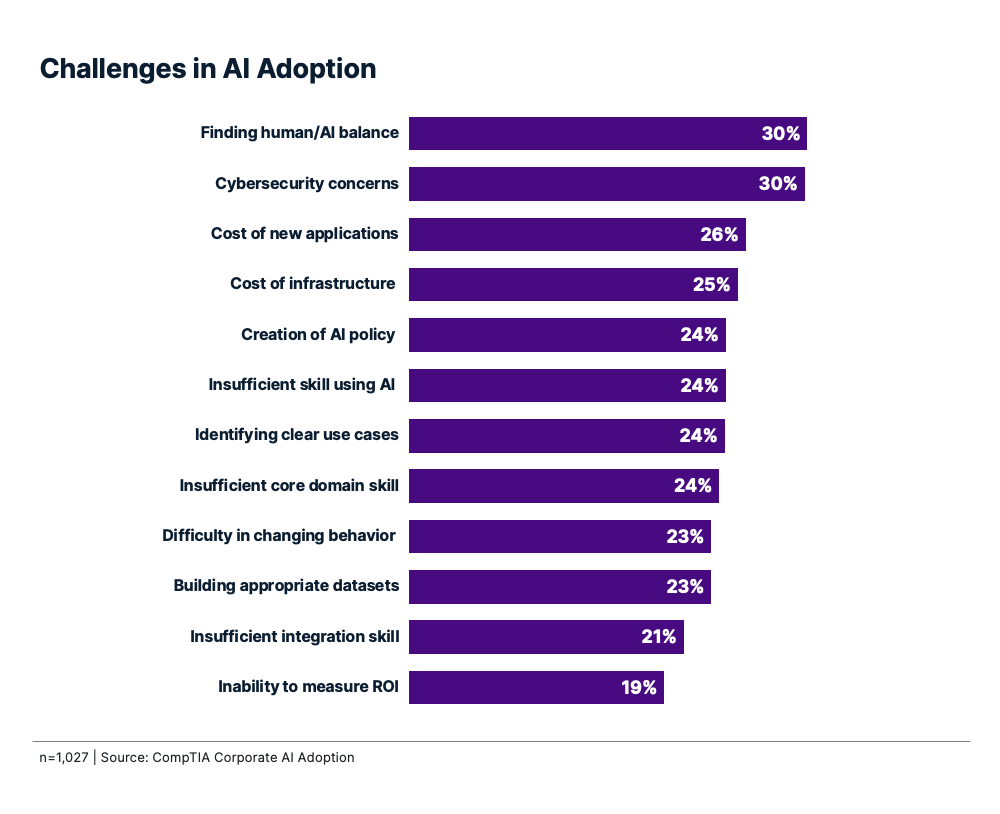
The list of challenges that companies have already faced or expect to face with AI adoption highlights an emphasis on technical issues but also shows the importance of behavioral change. Finding the balance between human effort and AI capability may be viewed as defining technical pieces of a workflow with associated handoffs, but quickly understanding the basics of this scenario will help employees see a long-term career outlook involving collaboration with AI.

Bar chart showing top challenges in AI adoption, with finding human/AI balance and cybersecurity concerns leading at 30%.

Even at an organizational level, clarity around use cases stands out as a challenge. This is more, though, than identifying use cases for each individual. For a business, the use case question is one of scale, of finding the best places where AI fits into operations. Translating individual efforts into results at scale is the entire purpose of a business, and solving AI for the first part is a different proposition than solving AI for the second.

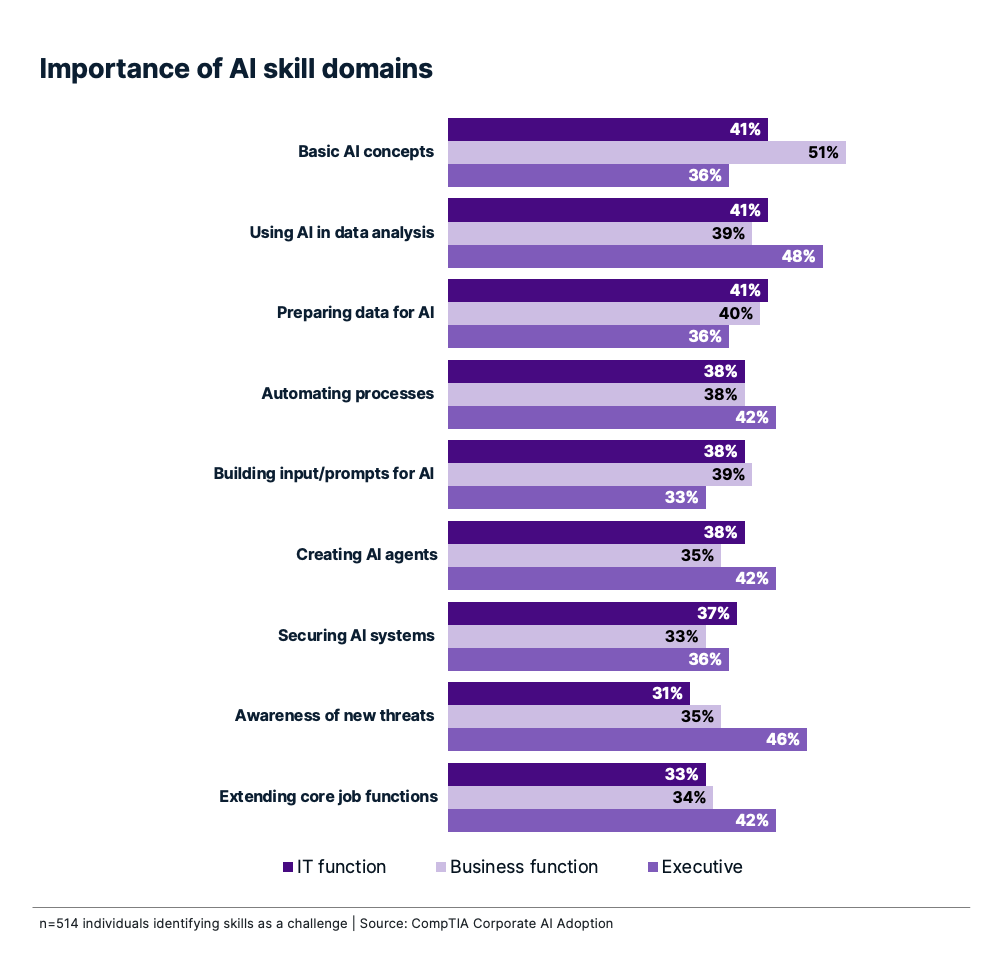
Skills feature in several different challenges that companies are facing, whether that is skill in using available AI systems, skill in making those systems available, or skill in core functions before even applying AI. Looking specifically at the importance of various AI-related skill domains, some patterns emerge that should inform any skill development strategy.

First, the largest gap between executive viewpoints and general workforce viewpoints is in the importance of AI fundamentals. In particular, individuals in a business role place a high degree of importance on understanding the basics. Based on media coverage or market sentiment, executives may assume this piece has been solved, focusing more on advanced topics such as data analysis or agent creation. 

There is a similar pattern in the use of data, where executives are focused on higher-order analysis rather than the management and preparation of data that enables that analysis along with general AI operation. The common thread is ensuring that the foundation is solid before attempting to build.

On the other hand, it is interesting to note that executives place a higher degree of importance on using AI to extend core skills compared to IT or business professionals. There may still be some disagreement around the current strength of those core skills, but this is another signal that executives are not pursuing “AI for the sake of AI.” It must be connected to the larger picture, whether that is organizational objectives or skill stacks.

Bar chart illustrating the perceived importance of various AI skill domains across IT, business, and executive roles.

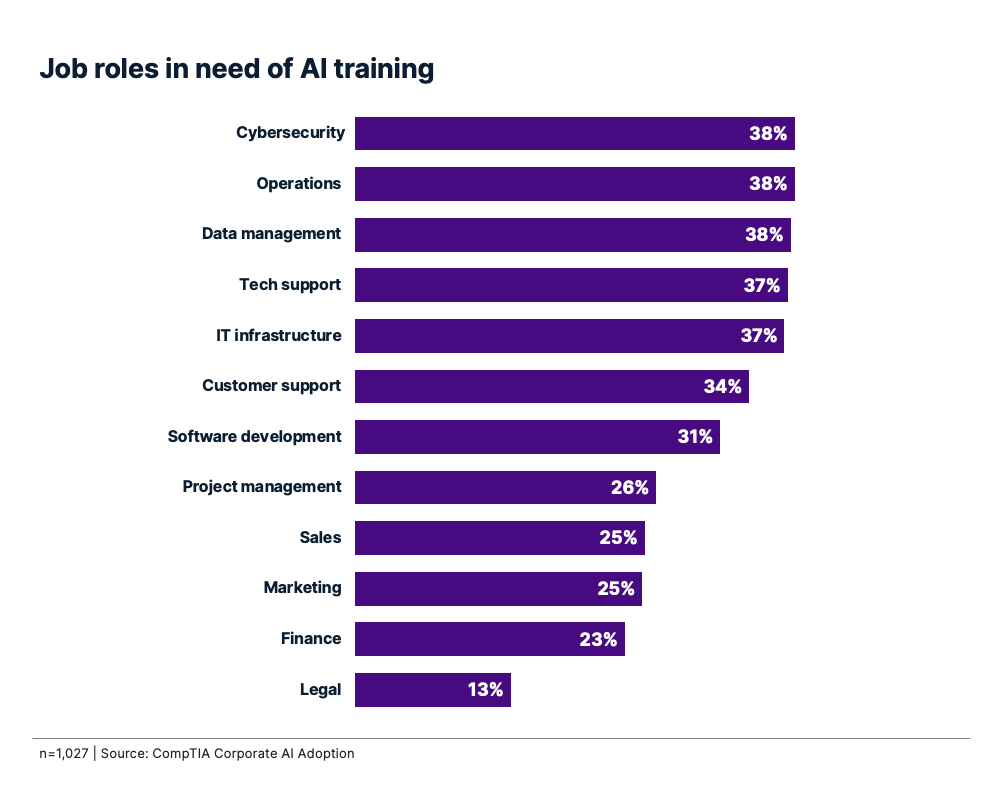
From a job role perspective, there is a clear emphasis on technology occupations. This is largely driven by the dual need in these positions, for both day-to-day and implementation skills. The general category of operations also ranks high, but more granular operational functions such as finance and legal rank low. This points to another gap between AI in theory and AI in practice: AI is often presented as a solution to general sets of problems, but the devil is in the details. 

Bar chart showing job roles in need of AI training, led by cybersecurity, operations, and data management at 38%.

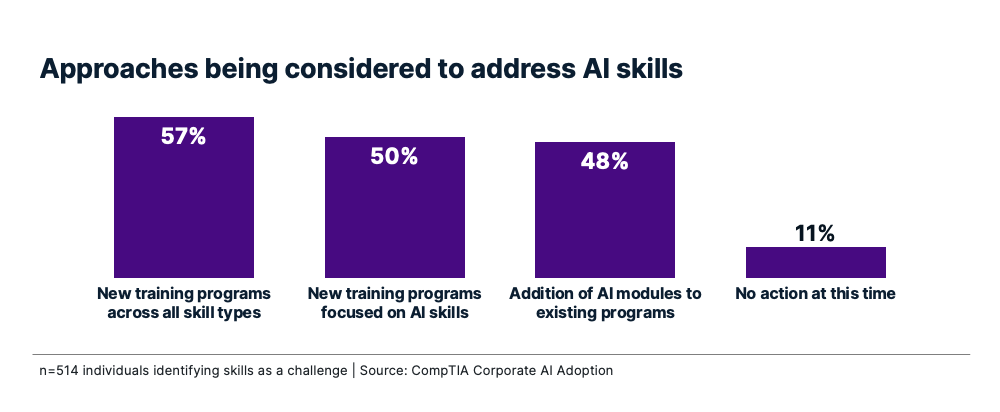
Among companies that identify skills as a challenge in AI adoption, the vast majority are planning to build some form of training initiative. In line with the needs of new skill-based approaches, new programs that take a broad view across all skill types are the most common plan. Other companies may be satisfied with their existing training programs and are expecting to either build AI-specific programs or incorporate AI modules into ongoing learning tactics.

Bar chart: 57% consider new training programs across all skills, 50% focus on AI skills, 48% add AI modules, and 11% take no action.

Much has been made about the pace of AI innovation and the difficulty of adopting a moving target. Businesses should not wait until AI is fully productized; nor should they immediately make plans based on the current form. Adoption plans—and skill-building strategies—should focus on the parts that are stabilizing now, with flexibility to adapt in the future.


3. Future success hinges on data, policy, and tech operations

  • Existing gaps in optimizing data usage will hinder AI adoption as data is needed for training
  • Organizations may be taking an optimistic view of capability to build AI policy, as many best practices are still being defined
  • Technology teams are expected to play significant roles in AI adoption, leading efforts in security, training, and support.


Data is not just a field where organizations expect to build workforce capabilities. It is also a primary ingredient in successful AI implementation. Even prior to the introduction of generative AI, companies were pursuing more advanced data analytics and realizing that they also needed to pursue stronger data management. Now that AI training has been added to the list of advanced data objectives, the priority of data operations is even higher.

Only 22% of companies feel that they are exactly where they want to be in the use of their data, with far more executives sharing this sentiment (43%) compared to IT staff (21%) or business staff (16%). The largest organizations also struggle the most (15% of organizations with 10,000+ employees). 

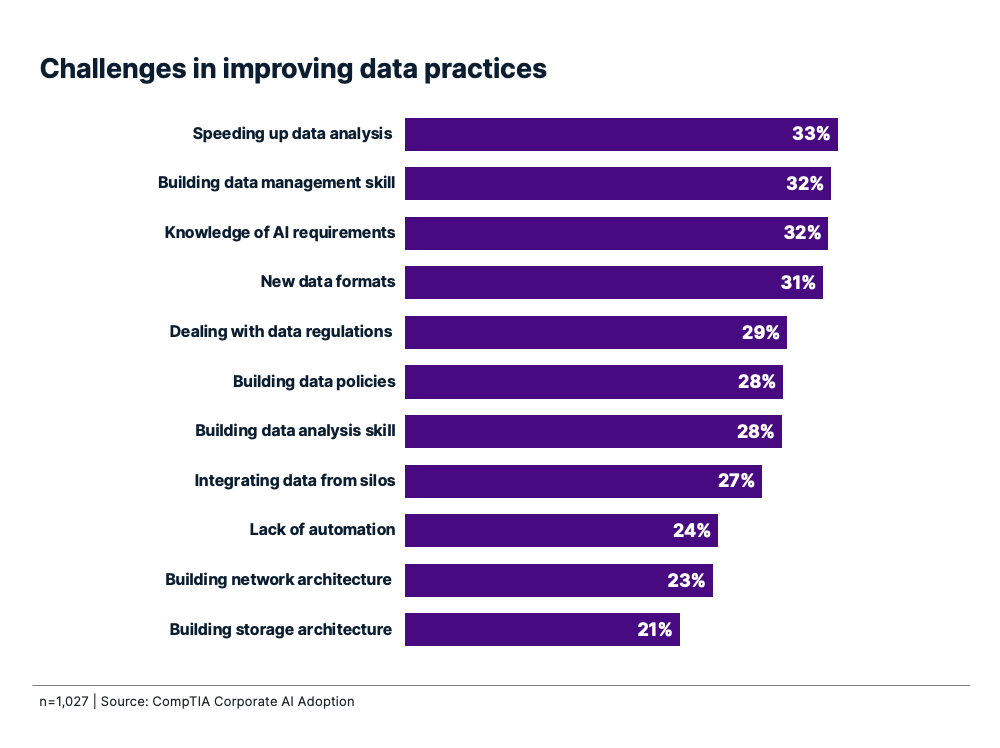
Bar chart showing challenges in improving data practices; speeding up data analysis (33%) is the top challenge listed.

Companies face several challenges in building strong data practices, ranging from process creation to skill gaps to technical issues. A well-defined process, backed by appropriate policies, will help speed up data analysis and drive compliance with regulations. Skills in data management enable skills in data analytics and data science to be more effective. And the proper architectures will provide comprehensive access to corporate data while laying a foundation for automation. AI can help solve some of these issues, but understanding exactly how to train AI is a prerequisite step, and layering AI on top of poor practices will exacerbate existing problems.

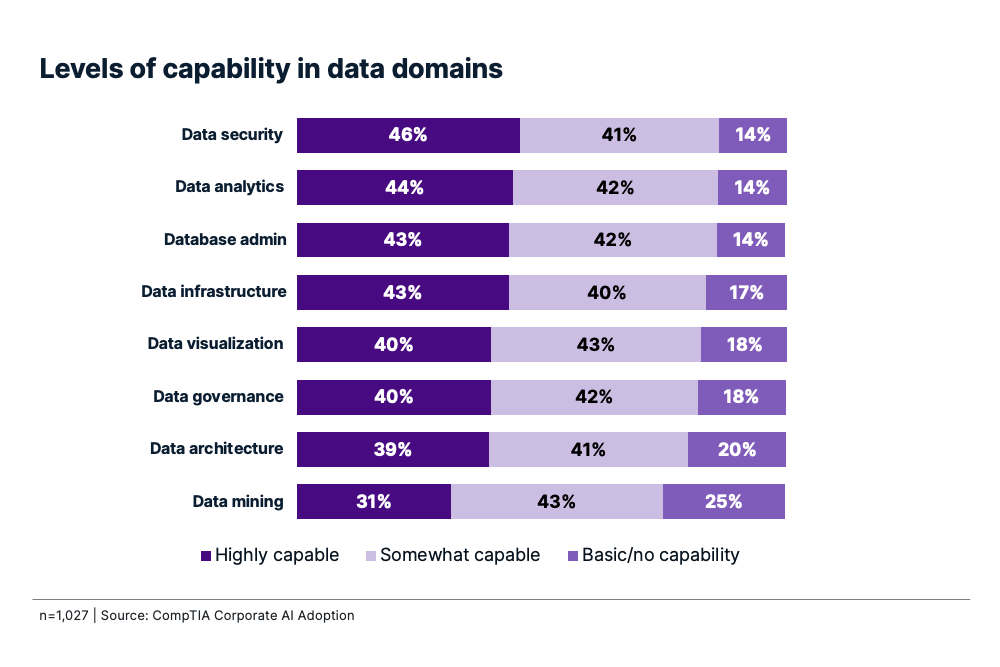
Consistent with previous CompTIA research, there is no area within data operations where a majority of companies feel they are highly capable. Data security and data analytics rank highly thanks to recent emphasis, but these remain limited by low levels of capability in database administration, data infrastructure, and data mining. 

Levels_of_capability_in_data_domains.png

With data, companies have enough experience to recognize where gaps exist. With policy, a lack of experience may be leading to inflated confidence. Nearly half of respondents (47%) feel that their organization is very capable of building AI policy. Again, this is led by executives (70%), with IT staff (51%) and business staff (35%) trailing behind. Surprisingly, there is little differentiation across company size, with 44% of both small businesses (fewer than 100 employees) and mid-size businesses (100-499 employees) rating their capability as very high.

asset_alt_text

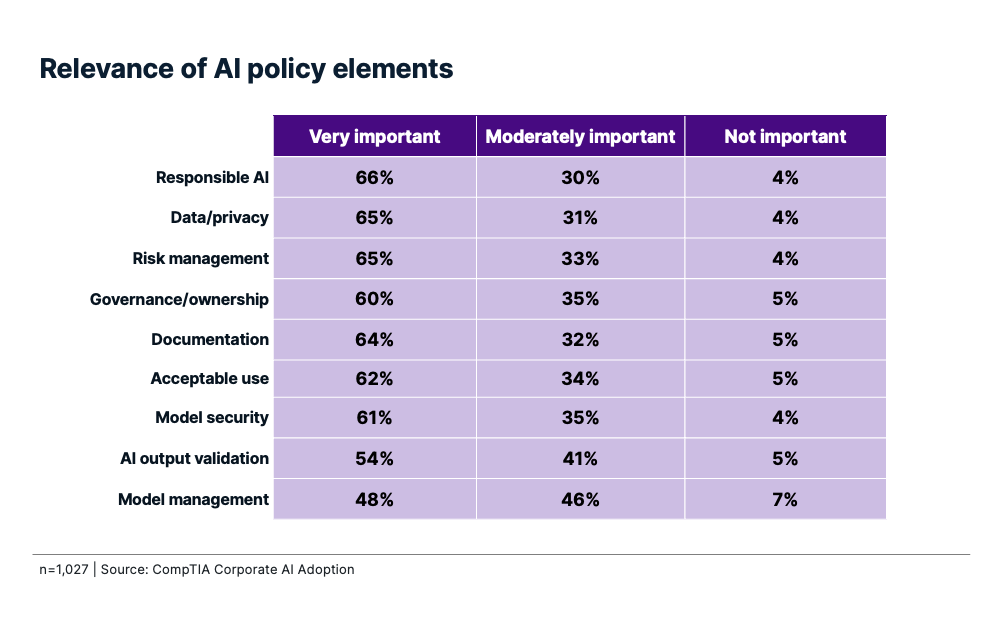
Given the high number of policy topics cited as being very important and given the instability of AI technology and corporate adoption at this point, it is highly unlikely that so many companies are truly prepared to build effective policies, especially those with limited resources to understand the deep implications or the changing regulatory space. Some policy elements—such as data governance or risk management—may be extensions of existing policies (assuming those policies exist). Other elements—such as defining responsible AI usage, building appropriate documentation for AI’s role in processes, and validation of AI output—are unique to AI and will require a broader understanding of best practices.

Another factor that will impact policy creation is the rising cost of AI. Organizations are quickly finding that unlimited access for the workforce is not feasible, so they are beginning to explore the right mix of access to tools based on job role. At the same time, a wide range of current workflow tools are starting to embed AI functionality, allowing workers to stay in flow rather than bring work back and forth between existing tools and chatbots. Technology teams are just beginning to craft AI-based system architectures that enable cost-effective extensions of current processes. 

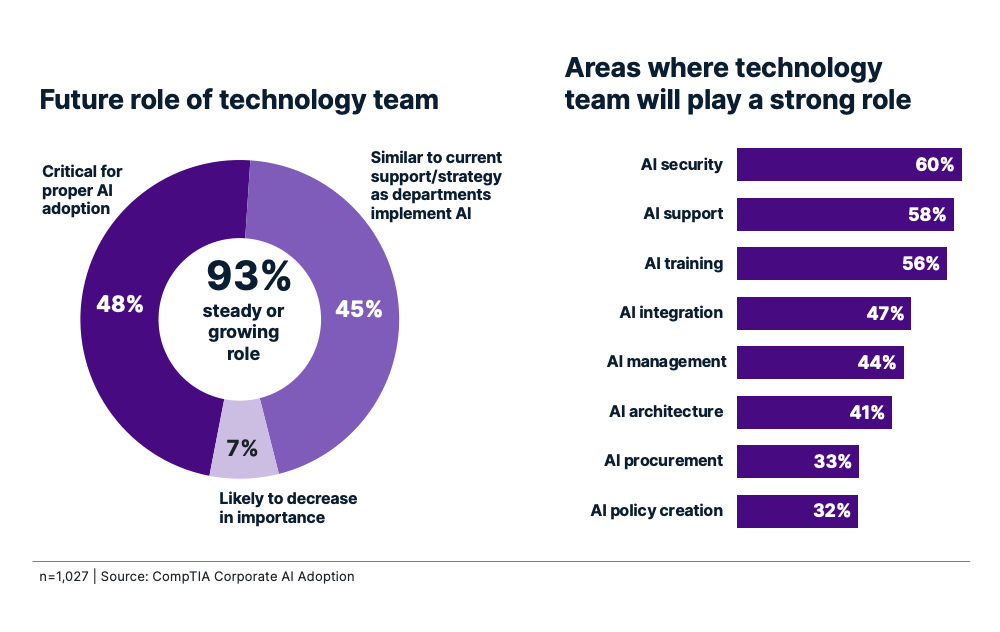
Infographic on tech team's future AI role: 93% expect steady/growing roles, focused on AI security, support, and training.

Those technology teams have been under a great deal of scrutiny during this most recent iteration of AI, as strong debate has risen around the relevance and function of many technology roles. That debate has some merit, especially as AI is transforming a wide range of roles across the economy, but in the broadest sense there is a clear view that these teams will remain a critical part of AI adoption and operation.

That viewpoint is likely growing as organizations gain a clearer understanding of AI adoption. Rather than having each employee expertly working alongside a chatbot, there is a deeper integration and abstraction taking place due to efficiency and cost. The final solution taking shape bears a strong resemblance to previous waves of technology, where backend infrastructure needed to be optimized and secured in order to deliver productive tools to end users.

Looking specifically at the different areas where technology teams are expected to take ownership or play a strong role, there are both familiar aspects and new expectations. Ownership of security and integration has been a constant theme since organizations came to terms with shadow IT, recognizing that business units were not equipped to handle these pieces. It is interesting to see support rank so highly, since technical support is commonly viewed as a prime candidate for AI disruption. Training is an area that may not be a core competency for many technology teams, but their understanding of the inner workings along with their role in creating integrated workflow makes this a growing demand.

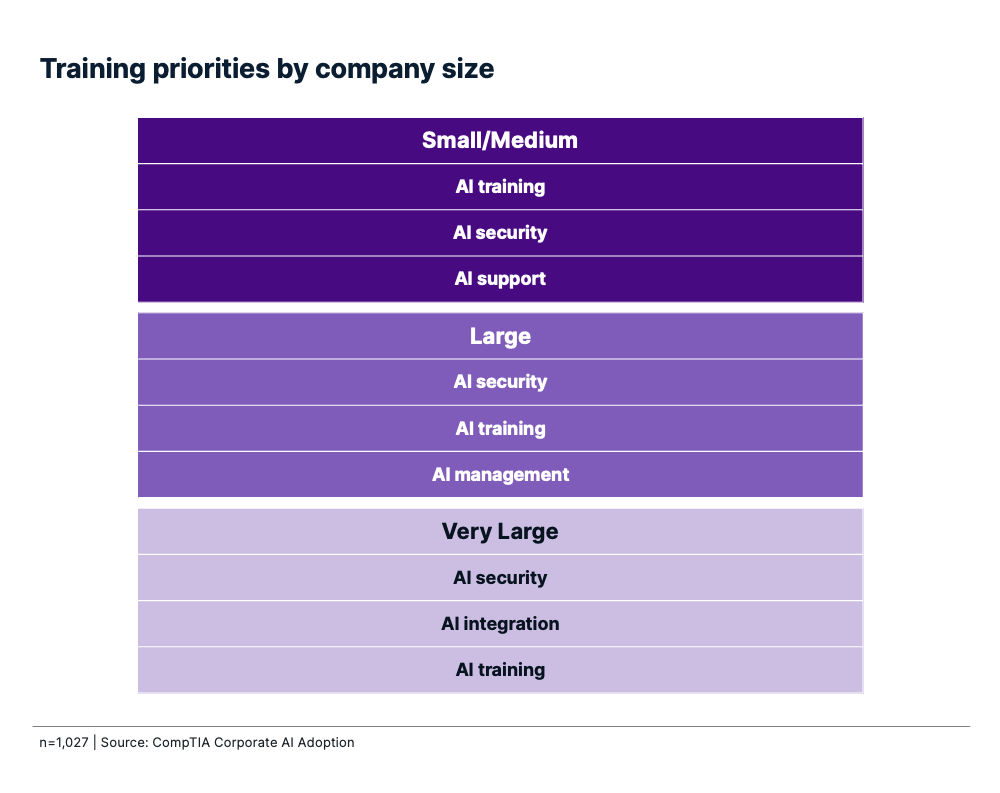
As the role of the technology team takes shape, there will be different needs for skill building depending on current skill levels and the overall state of strategic technology. Examining needs by company size provides one framing for the priorities where smaller companies are more focused on workforce training and support, large companies place emphasis on security and management of AI components, and the largest firms need to ensure that AI is properly integrated into complex digital workflows.

Chart showing top AI training priorities by company size, highlighting AI training and AI security as top priorities.


Conclusion

There is a great temptation to view AI in isolation. The disruptive potential and the substantial difference from previous software schemas drive a desire to focus on the unique aspects that need to be understood and mastered. The greatest value, though, comes in considering AI as a transformative extension of existing architecture. 

Tremendous technology investment has been made in the past decade, and many organizations are still grappling with the ripple effects of digital transformation and skill-based talent processes. Rather than starting from scratch, the more efficient approach is to consider how AI can expand on the lessons that have already been learned. Establishing strong connections between technology and business; strengthening foundations in data and governance; defining new workflows that balance human and AI contributions—these are all steps that IT and business leaders should be considering as they prepare their organizations for a future driven by AI.

Most critically, these leaders must create the skill-building methodologies that drive sustainable success. It has never been more important to identify the best talent and then develop that talent internally. Understanding the breadth of AI skills needed, from general workforce fluency to deep technical expertise, will be the key factor in successfully adopting AI and staying ahead of the competition.

Methodology

CompTIA’s Corporate AI Adoption study was conducted via a quantitative survey fielded online during June 2026. A total of 1,027 business and technology professionals completed the survey, yielding an overall margin of sampling error proxy at 95% confidence of +/- 3.1 percentage points. Subsets of the data and segmentations will have higher estimated sampling error rates. 

As with any survey, sampling error is present and will be higher for subsegments of the dataset. While non-sampling error cannot be accurately calculated, precautionary steps were taken in all phases of the survey design, collection and processing of the data to minimize its influence.

CompTIA, Inc. is a member of the market research industry’s Insights Association and adheres to its internationally respected Code of Standards. Any questions regarding the study should be directed to CompTIA Research and Market Intelligence staff at research@comptia.org.

About CompTIA

CompTIA, Inc. is the leading global provider of vendor-neutral training and certification products in the information technology (IT) space. More than four million CompTIA certifications have been awarded to current and aspiring technology workers, business professionals, government and military personnel, career changers, students and others. Working in partnership with thousands of academic institutions, governments, training providers and workforce development organizations, CompTIA uses best-in-class learning solutions, industry-recognized certifications and career resources to help job seekers reach their full potential and employers develop skilled technical talent.

About CompTIA Research

Seth Robinson is the vice president of research at CompTIA, overseeing market research and providing insights on workforce trends and technology adoption.

Amy Carrado is the senior director of workforce and internal research at CompTIA, creating data definitions for the tech workforce and driving analysis of tech careers.

Anna Matthai is the director of research and market intelligence at CompTIA, managing survey operations and building synopses of tech workforce dynamics.