Trends
- AI utilization is pervasive, but uneven
- Corporate leadership sets sights on AI-driven productivity gains, despite backtracking when AI performance falls short
- AI skilling strategies are still more reactive than proactive
- Untangling AI’s direct and indirect impact on the workforce
- Career ladder conundrum in the age of AI
Spotlights
- CompTIA AI Framework
- What is agentic AI, and what role will it play in enterprise workflows?
- Phases of enterprise AI implementation will guide skills development planning
Since the emergence of the modern artificial intelligence (AI) era, it often seems as if AI has already gone through more Hype Cycle peaks and valleys than most technologies experience in a lifetime. Announcements of profound breakthroughs, such as besting the Turing Test, inflate expectations to lofty heights, only to follow with the disillusionment that comes with puzzling AI hallucinations or results that underwhelm.
This dynamic inevitably leads to endless corporate anxiety as leaders attempt to keep their fear of missing out (FOMO) or fear of making the wrong AI bet in check. Despite the lessons learned from prior waves of era-defining innovation – notably, transformative change is harder and takes longer- organizations face the reality of having to answer to investors, boards, staff, and customers. The status quo of inaction is usually not an option.
This latest research from CompTIA is part corroboration and part exploration. A quantitative survey commissioned by CompTIA of more than 1,100 U.S. business respondents seeks to corroborate established patterns of AI use, while exploring new facets of the challenges companies face in navigating the many moving parts of AI deployments in the enterprise. This research provides a glimpse into how the average company contends with AI developments.
Adoption rates are a key barometer in assessing user uptake of emerging technologies. This seemingly straightforward measure, however, may show vastly different results due to varying definitions of what constitutes use and varying degrees of representation among user and company types.
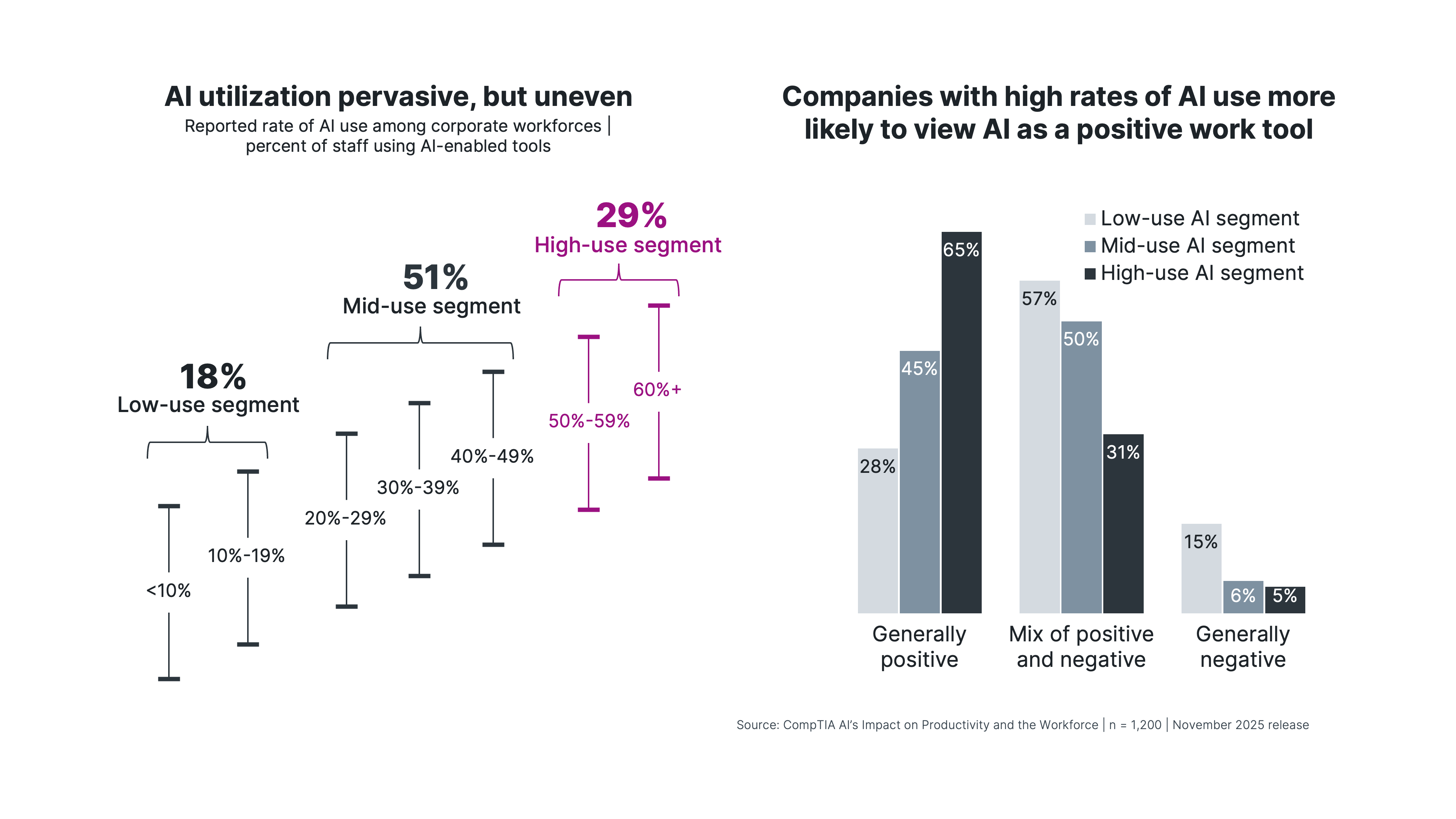
CompTIA’s research uses an estimation approach to group AI usage into three tiers. The overall weighted average adoption rate across all respondents works out to about 37%. The middle tier translates to 20% to 49% of workers using AI on the job and accounts for 51% of the total.
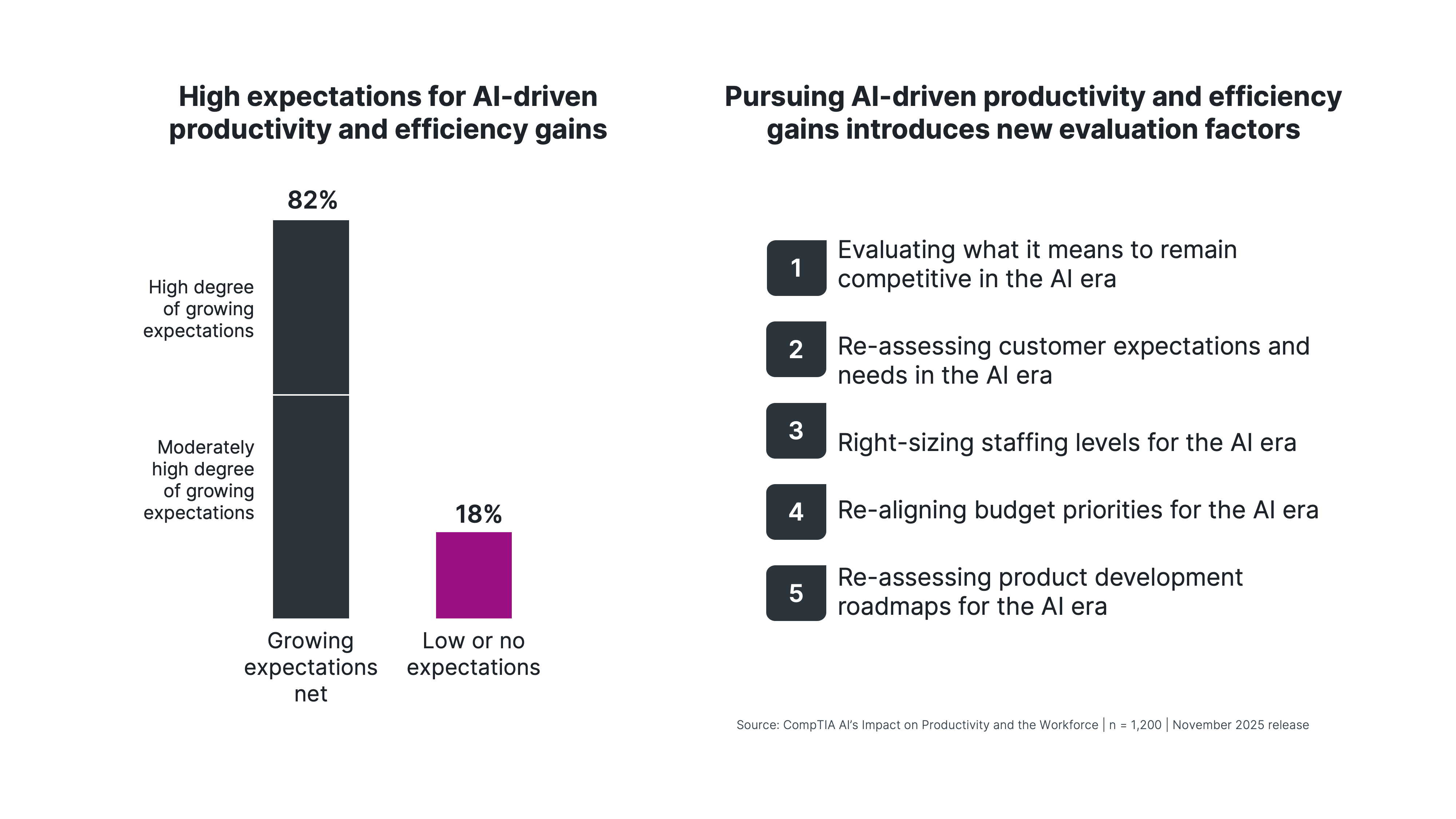
Higher rates of adoption equate to higher levels of direct or indirect investment in AI. Expectations are growing among corporate leadership, with more than 8 in 10 (net) indicating urgency to see results. Among the high-use AI segment, a net 92% report growing expectations for AI to deliver productivity and efficiency gains in their business.
The most ambitious corporate users are thinking broadly about the possible transformative effects of AI across every facet of their organization. AI roadmaps discussions go well beyond the technical and encompass customer expectations, staffing decisions, budget prioritization, and competitive positioning.
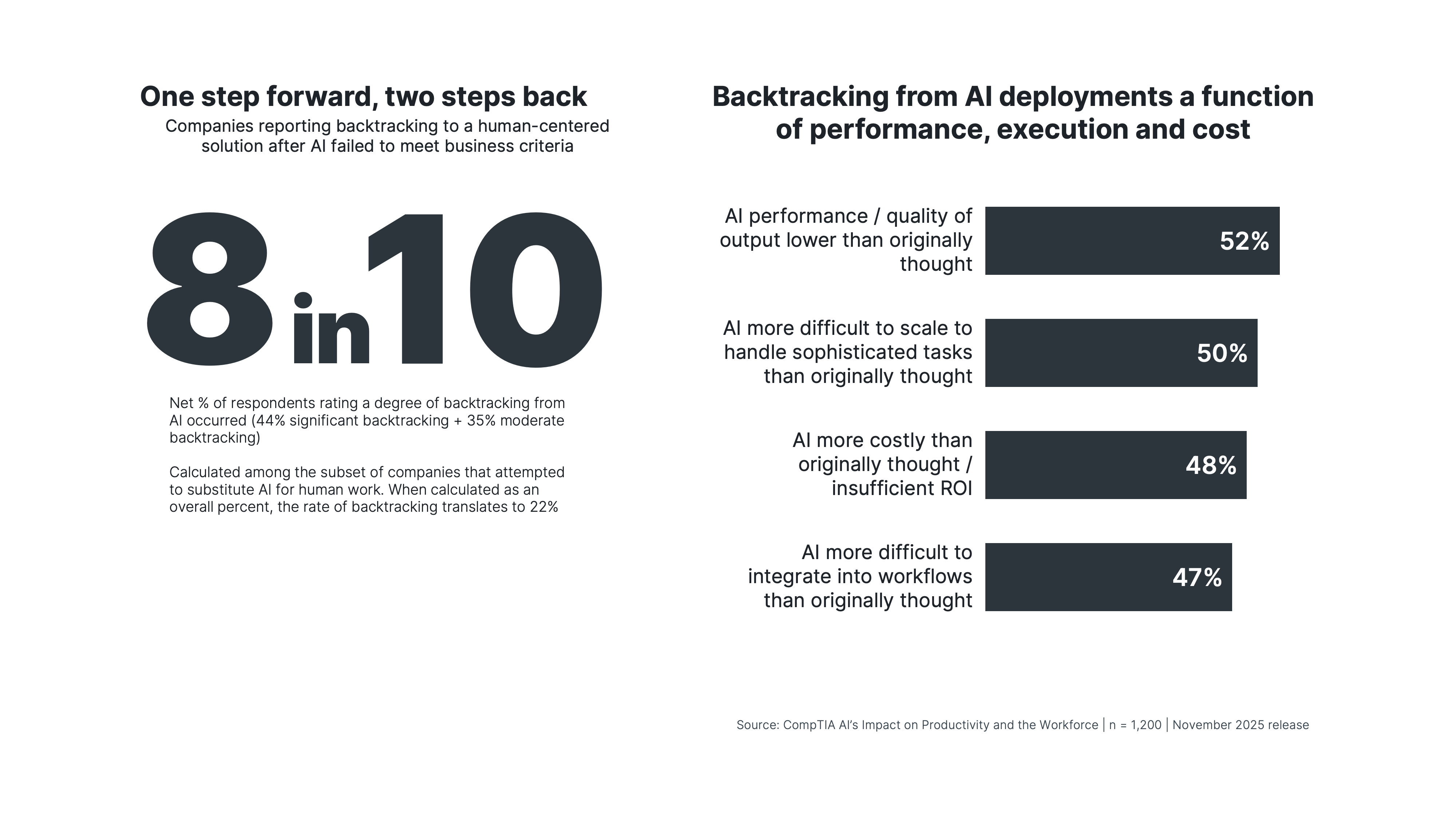
The data from this research indicates that most companies experience a mix of success and failure with AI deployments. This is not necessarily a negative, but rather a healthy dynamic in the evaluation process as companies experiment with AI pilot projects in planned and sometimes unplanned ways.
AI deployments that fall short tend to signify more than technological shortcomings. Sufficient attention to workflow processes and skills training for staff is equally important to successful implementations.
An underlying theme of this report is the parallel seen in AI’s progression as an emerging technology and prior waves of evolutionary technologies. This pattern continues with the approach many companies take with training their employees in AI skills.
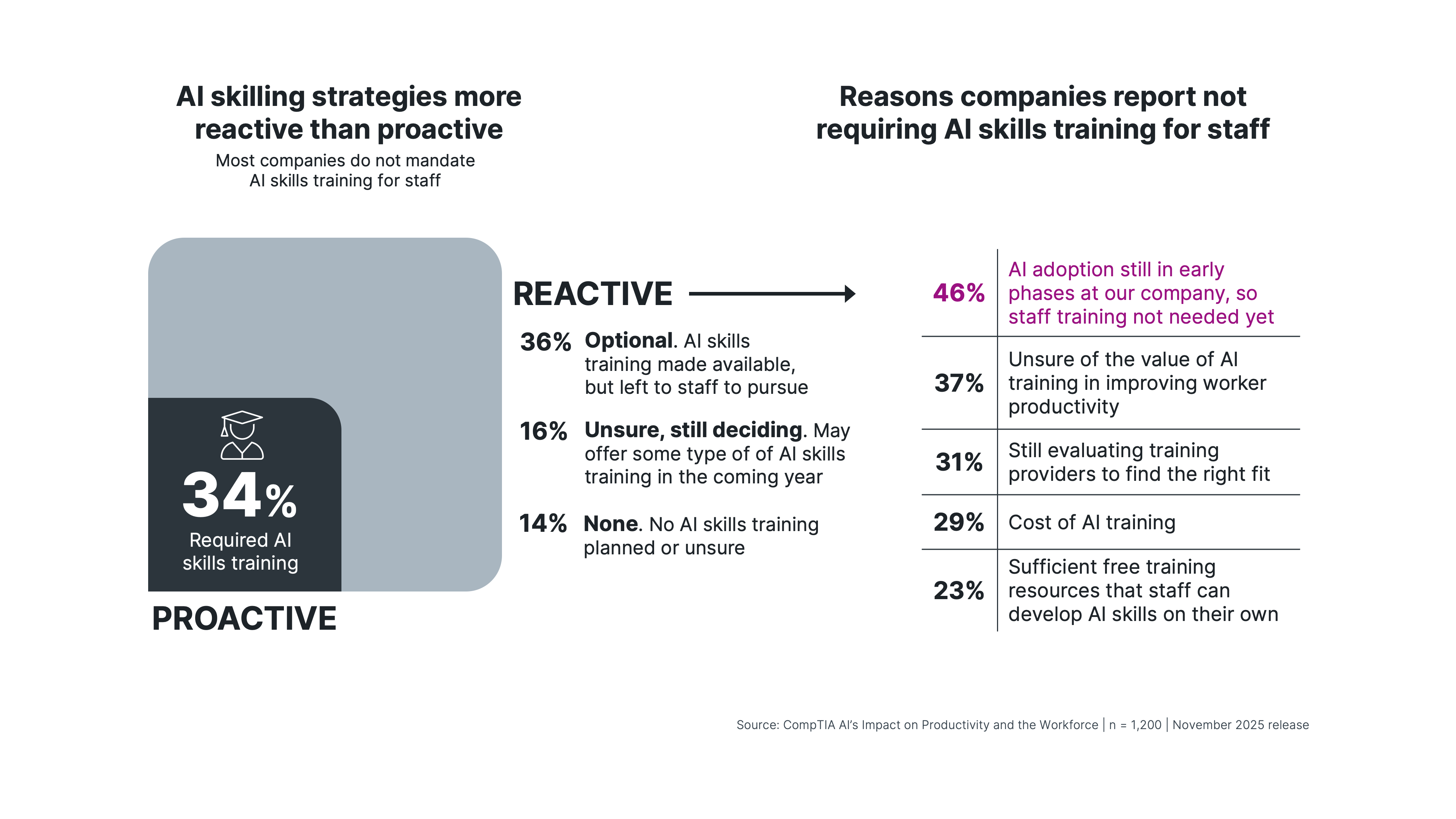
To date, about 1 in 3 companies report mandating AI training for staff. Think of this as the proactive segment of companies seeking to get out in front of identifying and addressing skills gaps. Modest investments of time and resources in industry-recognized training and certification almost always have a multiplier effect in returning value via productivity gains, better performance, and more engaged staff.
Among the majority of companies in what can be characterized as the reactive camp for AI skills training, one or more factors may be at play. The data suggests a certain “chicken or the egg” paradox. Forty-six percent of companies report being in the early stages of AI, so they believe skills training for staff is not needed yet. But the reason they may be in that position is because staff do not possess the AI skills to move AI deployments forward. Waiting and reacting with a skills development plan when there is a crisis moment puts strain on the business and staff.
In 1930, one of the giants in the field of economics, John Maynard Keynes, wrote about the concept of technological unemployment. He expressed both concern for the negative effects of technological advances outrunning the labor market’s ability to absorb the changes, and a recognition of the positive upsides of higher living standards across society.
Fast forward 50 years to the dawn of the personal computer era, and then again to the internet and ecommerce era; mobile device and app era; cloud era, data era; blockchain era; and now, the AI era. The concept pondered by John Maynard Keynes nearly 100 years ago has waxed and waned during each era, with varying degrees of debate over how to make sense of the positives and negatives of technological advancements.
One school of thought asserts AI will ultimately conform to historical patterns. AI’s relationship to human effort via automating and augmenting workflows will mean many job roles will change; new job roles will emerge, and some job roles will fade.
The other school of thought argues, “This time will be different.” Regularly, news headlines report startling predictions of AI-induced doom. Everything from dark humor nods to sci-fi plots of the “robots taking over,” to tech industry luminaries making rather absurd predictions.
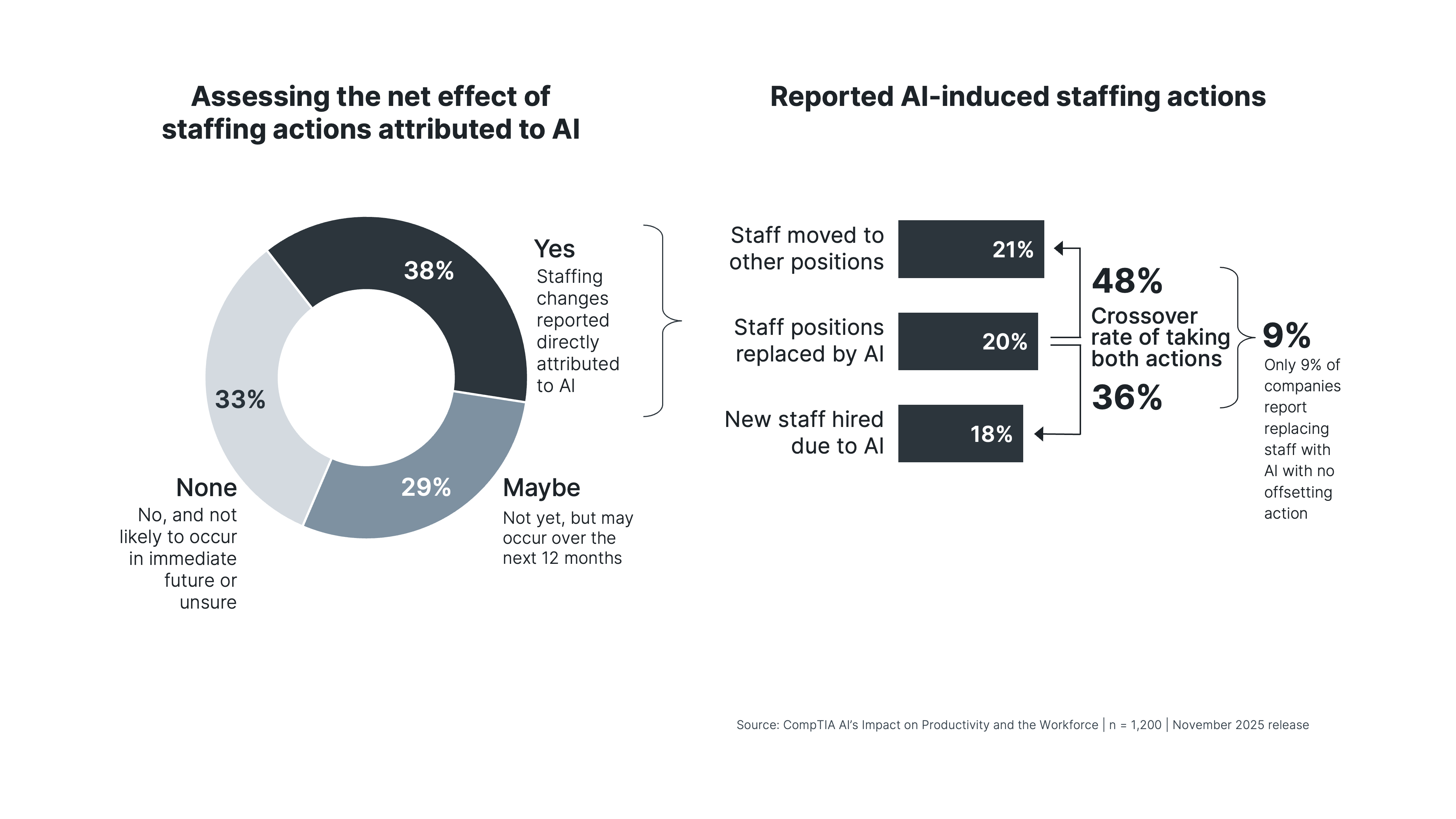
The fact is, no one knows for sure how the next decade, or even the next year, will unfold with AI. The CompTIA research in this area attempts to understand the actions companies report taking or plan to take over the next 12 months.