Understanding how to build a data-driven organization.
Data acumen is becoming a prerequisite for AI implementation
As companies are discovering the latent costs of integrating AI into architecture and workflow, data is becoming more prominent as a focal point. Not only is well-organized data needed to train AI models and deliver viable results, but data skills throughout a business are needed to transform information into action.
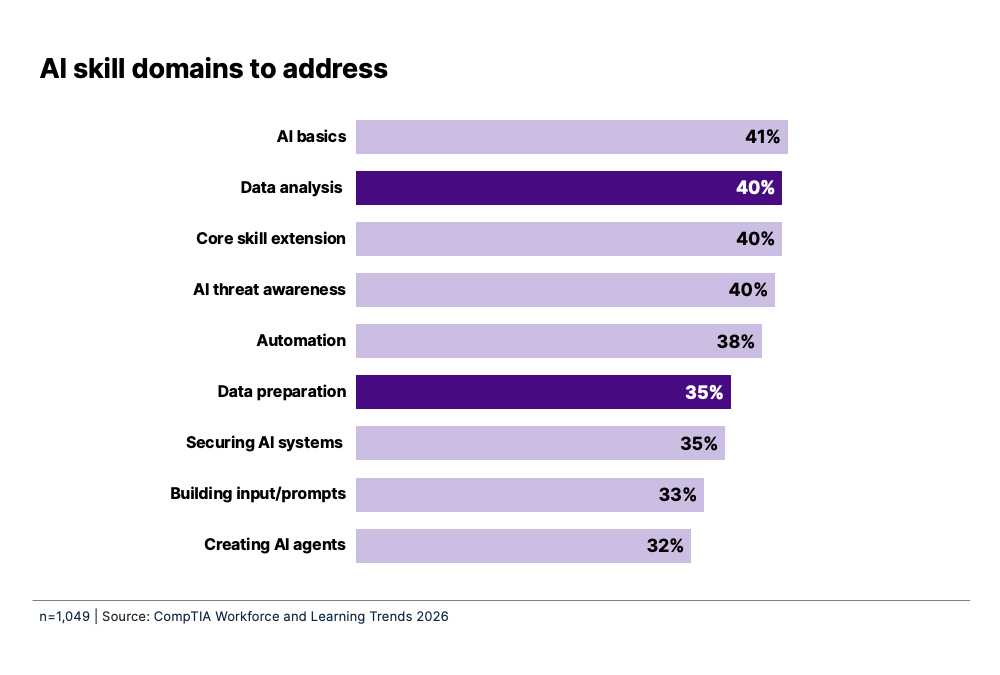
The importance of data skills within AI operations is clear when examining the many different skills companies plan to address for AI success. Both data analysis and data preparation rank above the critical skills needed for securing AI systems and the high-focus area of building prompts to interact with AI tools. Consistent with other CompTIA research, data preparation appears to be undervalued since high quality and consistency are necessary for proper analysis.
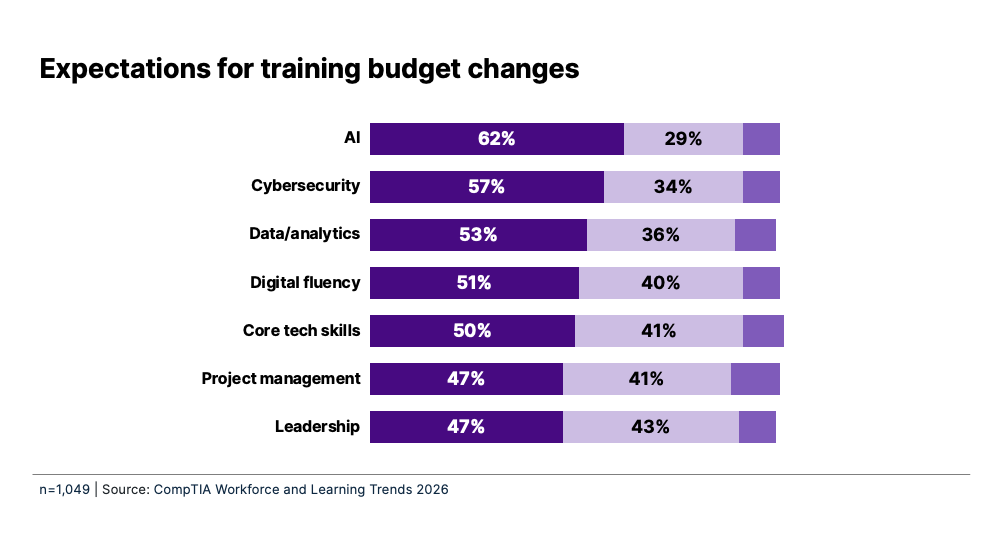
Following the assessment of data skills as a priority, over half of companies surveyed plan to increase budget for training around data skills. Here, there may be multiple aspects of skill building that an organization plans to develop. Along with the deep technical skills needed for data management and interpretation, some degree of data acumen is needed across the entire workforce. This may be captured in training around digital fluency, or it may be handled separately as part of a broader data skills initiative.
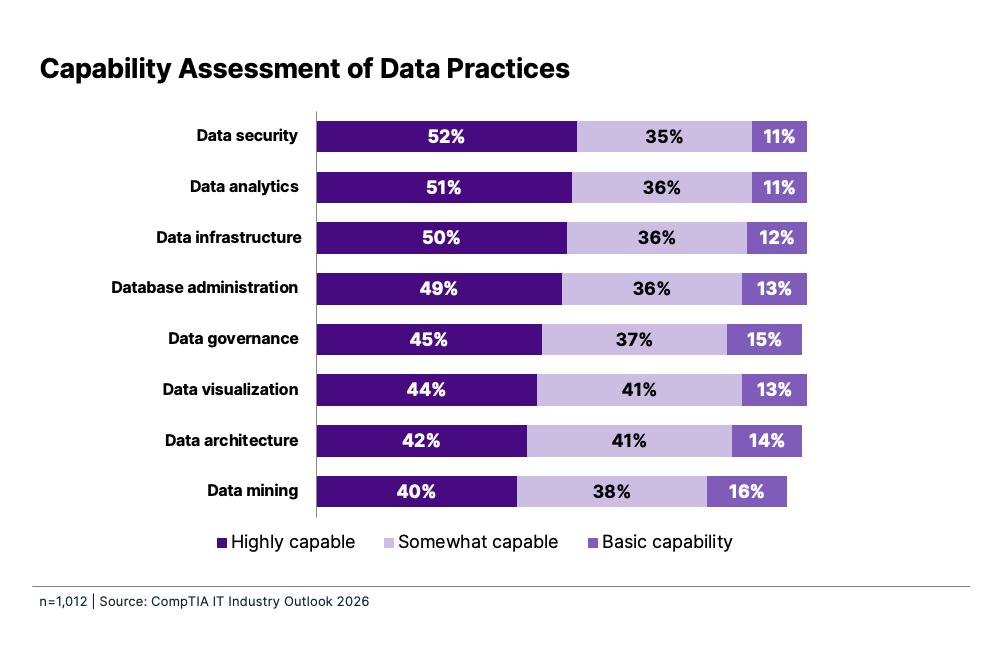
The self-assessment of capability levels across the different practices that make up a data discipline highlights three takeaways for business leaders considering skill development. First, the areas of security and analytics have been top of mind for several years; that focus may have actually built a higher degree of expertise, or it may be driving inflation of current capabilities.
Second, as mentioned before, the areas related to the management of data—including database administration, data architecture, and data mining—are foundational pieces that enable advanced activities. While these areas are not viewed as drastically lower in capability than areas such as security or analytics, they may still require more attention and education than currently planned.
Finally, the area of data governance falls in the middle of the assessment, but it is a unique skillset that is more important than ever in the face of changing regulations about handling data and ensuring privacy. Skills in governance and compliance are adjacent to technical skills and may necessitate dedicated individuals depending on the scope of data concerns.
AI skills have replaced cybersecurity skills at the top of the wish list for most organizations, but data skills cannot be ignored. As workflow has become more digitized and automation more prized, a full range of data skills from fluency to deep expertise will be the key to unlocking the potential of a digital organization.