When nonprofits talk about expanding access to tech careers, the focus is increasingly on momentum and possibility. Employers are actively seeking skilled talent, communities are investing in new pathways, and funders are asking sharper questions about scale, sustainability, and impact. Taken together, these pressures are accelerating meaningful change in workforce development.
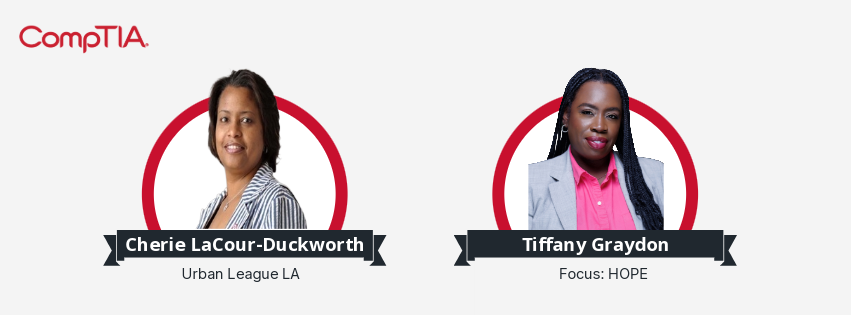
These themes were explored in a recent CompTIA webinar led by Dr. Mardy Leathers, CompTIA Economics and Public Policy Advisor, featuring Tiffany Graydon, Director of Workforce Development and Education at Focus: HOPE, and Cherie LaCour-Duckworth, Vice President of Workforce Development at the Urban League of Louisiana. Drawing on their combined decades of experience, these leaders shared practical insight into how nonprofits are transforming workforce development training programs into lasting economic mobility.
What emerged was not a pre-packaged model or a prescriptive framework, but a set of grounded ideas shaped by real-world implementation experience. The takeaway is straightforward, and optimistic: opportunity expands when workforce development moves beyond isolated programs and begins operating as an integrated talent pipeline system.
Talent gaps are real, but they are not what we think
When employers say they can't find qualified candidates, the issue initially sounds like a straightforward talent shortage. On closer inspection, it’s often a definition problem. The skills employers need and the signals they rely on to identify them are not always aligned.
LaCour-Duckworth described employers reaching out with urgent workforce needs, only to default to hiring criteria that narrow the pool before the conversation even begins. “Just looking for a college degree will not close your gaps,” she said. Yet for many organizations, degrees remain a default filter, even when they do not reliably predict job performance or long-term success.
Shifting the focus from degrees to ability changes the conversation. When nonprofits work directly with employers to define the skills and knowledge required to be successful in a role, pathways open up for individuals who have been historically excluded from traditional routes into technology careers. Industry‑recognized credentials, like those offered by CompTIA, play a significant role here. Certifications aligned to real job requirements give candidates a way to demonstrate their ability without waiting for a four-year degree.
This shift also forces more discipline around how success is measured. Instead of designing programs based on generalized labor market data or counting completions as the primary outcome, effective workforce development efforts increasingly emphasize:
- Defining roles and required skills directly with employers
- Validating readiness through demonstrable, job‑aligned skills
- Measuring results through placement, retention, and advancement over time
Taken together, this approach replaces broad optimism with precision. It aligns closely with CompTIA’s long-standing emphasis on skills‑based validation and reflects a more practical understanding of how talent pipelines actually function. Perhaps most important, it creates space for realistic progress.
As LaCour-Duckworth put it, “The gap is so wide, it’s kind of difficult to close it. But you can narrow it.” That perspective allows organizations to focus on steady, observable gains rather than losing momentum in pursuit of perfection.
From training programs to pathways that hold up in real life
Traditional workforce development programs often assume a linear journey: enroll, complete training, get hired. For many adult learners, that sequence simply does not match reality.
Graydon described making a deliberate break from this model at Focus: HOPE. “For many years, people were our product,” she said, referring to how nonprofits historically designed training and then tried to place graduates. When the results proved inconsistent, they pivoted to a talent pipeline management approach that treated employers as the end customer.
“We convene employer-led collaboratives by sector,” Graydon explained, working with other organizations to align on role definitions. What one organization labels “help desk” or “network support” may differ significantly from another’s expectations. Establishing shared definitions allows pathways to be engineered around the skills employers value, not job titles alone.
Those pathways often start with digital fluency before progressing into certifications such as CompTIA Tech+, which both speakers pointed to as a foundational credential for digital literacy across industries. From there, learners move into role-aligned certifications like A+, Network+, or Security+, depending on employer demand and individual interest.
As LaCour-Duckworth noted, digital fluency is not optional, even for participants already employed. “It starts with digital fluency… how to use a computer, data awareness, familiarity with workplace systems,” she said. “A lot of people, even though they’re on the job, they may not know those things.”
At the Urban League of Louisiana, pathway design is similarly employer-informed but explicitly built for accessibility. Many participants arrive with limited post-secondary education or long gaps in employment. “You have to co-design these programs so that everybody can have a fair opportunity to compete for the jobs while still educating them,” LaCour-Duckworth said.
Effective pathways tend to be sequenced rather than front-loaded so they can:
- Establish digital fluency and workplace readiness
- Layer in stackable credentials such as CompTIA A+, Network+, or Security+
- Introduce job shadowing before full placement
- Transition participants into paid, on-the-job learning
This structure reflects an economic reality: learners often cannot stop earning for extended periods. Early exposure to work conditions reduces attrition and mismatch, making paid, work‑based models a natural next step.
Apprenticeships as infrastructure, not a side program
Throughout the discussion, apprenticeships surfaced as a central mechanism rather than a specialized add-on.
“We bring the reality of the job into the classroom before they actually get hired… so they can really put to use the practical learnings,” LaCour-Duckworth said, describing how participants rotate through job shadowing across multiple employers before placement. This approach gives individuals insight into different expectations, company cultures, and working conditions, while employers gain a more complete view of potential hires.
Both organizations also sponsor internal apprenticeships, modeling the system they’re asking employers to adopt. At Focus: HOPE, registered apprenticeships are embedded alongside credential pathways, with CompTIA certifications serving as milestones.
Graydon emphasized how certifications and apprenticeships reinforce each other. Certifications, she noted, “provide the direct, credible pathway to opportunity,” particularly for individuals who cannot afford to go years without wages. Apprenticeships allow learners to earn while completing credentials, with pay increasing as their skills and responsibilities grow.
“Let me put you to work first,” LaCour-Duckworth said. Income, confidence, and financial literacy often create the conditions for sustained learning, not the reverse.
Funding, sustainability, and discipline
Funding remains the constraint nonprofits cite most often. LaCour-Duckworth outlined familiar challenges: fragmented funding streams, rigid performance measures, and limited flexibility to support participants holistically.
LaCour-Duckworth also pointed to structural challenges that go beyond individual grants. Funding streams are often fragmented across federal, state, and philanthropic sources, each with different rules and performance requirements. In her experience, sustainability improves when funding, policy, and employer partnerships are intentionally aligned rather than managed in silos.
At Focus: HOPE, Graydon described how losing a major funding source years ago forced a strategic shift in their thinking about funding. Today, their workforce development efforts are supported by a mix of sources with alumni giving playing an understated but critical role. “Never discount the power of the individual donor,” she said.
Graydon shared that several alumni regularly contribute small monthly donations, making it an ongoing commitment. Over time, those recurring contributions add up, creating a reliable source of support that reflects both trust and long‑term connection to the program’s impact.
Employer funding also follows trust. When employers help design pathways and see clear alignment with credentials and job readiness, many invest directly in training. In those cases, the talent pipeline becomes a shared asset rather than a transactional service. Graydon also emphasized that once employers trust a pipeline, they often invest even when immediate hiring is not guaranteed, viewing the talent pool itself as a shared regional asset.
Preparing for AI without chasing the hype
When the conversation turns to AI, neither leader sees a need for alarm or hype. Preparation, they agreed, starts with fundamentals, and digital fluency is still the baseline. Layered on top are durable “soft” skills such as problem solving, communication, and adaptability. Credentials tied to emerging areas, such as CompTIA AI Essentials, make sense only when integrated into broader pathways rather than treated as standalone fixes.
Graydon noted that many industries undergoing transformation no longer define themselves by their legacy sector. Employers need workers prepared for evolving roles, not just current openings. Pathways must therefore emphasize movement and adaptability.
Duckworth underscored the core point. Readiness for an AI-driven economy is “not just about technical skills.” It’s about combining literacy, hands-on experience, and adaptability so people can navigate change.
When AI is viewed as a productivity tool rather than a threat, the real advantage comes to those who know how to use it well. In that sense, AI skills function much like any other: they amplify capability when paired with foundational knowledge and experience.
What this means for nonprofits now
Taken together, these ideas point to a clear conclusion. Effective workforce development is less about perfect programs and more about alignment: with employers, with learner reality, and across funding sources.
The strongest models work as ecosystems where nonprofits function as talent pipeline managers, and employers share ownership of career pathways. Credentials such as CompTIA Tech+, A+, Network+, Security+, and AI Essentials are used intentionally, as markers of capability within a broader system rather than as ends in themselves.
This work is slower and less splashy than launching new initiatives. But it is how tech opportunity expands without losing credibility, trust, or momentum.
Dive deeper into CompTIA’s workforce development conversations and hear directly from the leaders behind these approaches. Watch the full discussion to explore how credentials, employer alignment, and apprenticeships come together in practice.