Structuring knowledge, skills, and tasks to achieve positive AI outcomes
Mirroring the pattern of prior waves of disruptive technologies, artificial intelligence (AI) will transform the workplace on multiple fronts. From automating tasks to augmenting human effort, AI will simultaneously create, reshape, and displace job roles and functions. Organizations face new challenges in navigating the complexities of a rapidly changing future of work.
- Evaluation: Filtering out the hype and “noise” to focus on value-add use cases from pilot to production
- Orchestration: AI is not monolithic; how the pieces fit together is as important as the pieces themselves
- Future readiness: Building towards a future ready state is a process; critical skills development coupled with workflows, compliance, ethics and more
CompTIA jobs taxonomy <> CompTIA AI framework
CompTIA’s tech jobs taxonomy defines the job families, job roles and underlying detail of the tech workforce. CompTIA’s AI framework extends this approach.
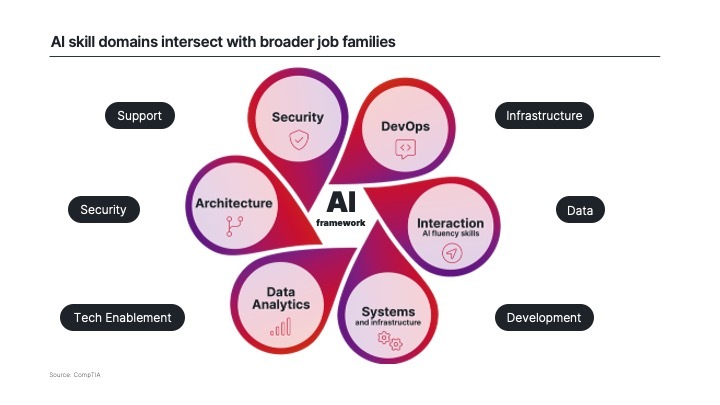
As an enabling technology, AI, and the skills that accompany it, will permeate every component of the framework. At the same time, every component of the framework must work in concert to achieve positive AI outcomes. Skills development flows in both directions.
Recognizing there is more to AI than LLMs, CompTIA’s AI framework is unique in providing a holistic approach to strategic planning and implementation.
AI’s rapid, disruptive growth contributes to…
- Fear of missing out
- Fear of falling behind
- Fear of making the wrong bet
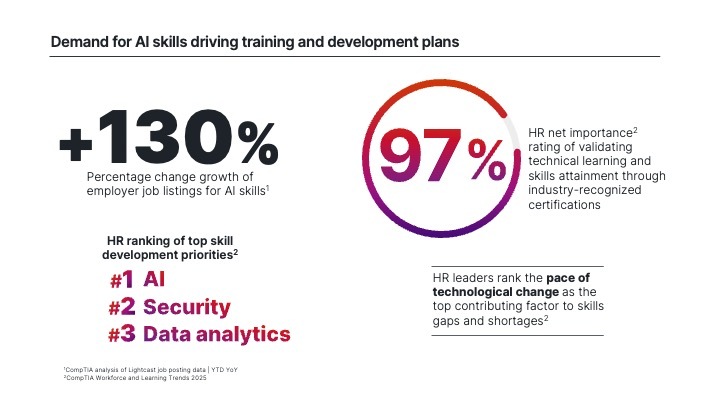
CompTIA’s commitment to unlocking potential, overcoming confidence gap barriers, and equipping anyone seeking to start or advance in a career in technology with the skills and on-ramps to do so, serves as our guiding principles with the AI framework.
For more on AI:
AI Essentials offerings
Building AI Strategy whitepaper
AI Careers+ job role modules