
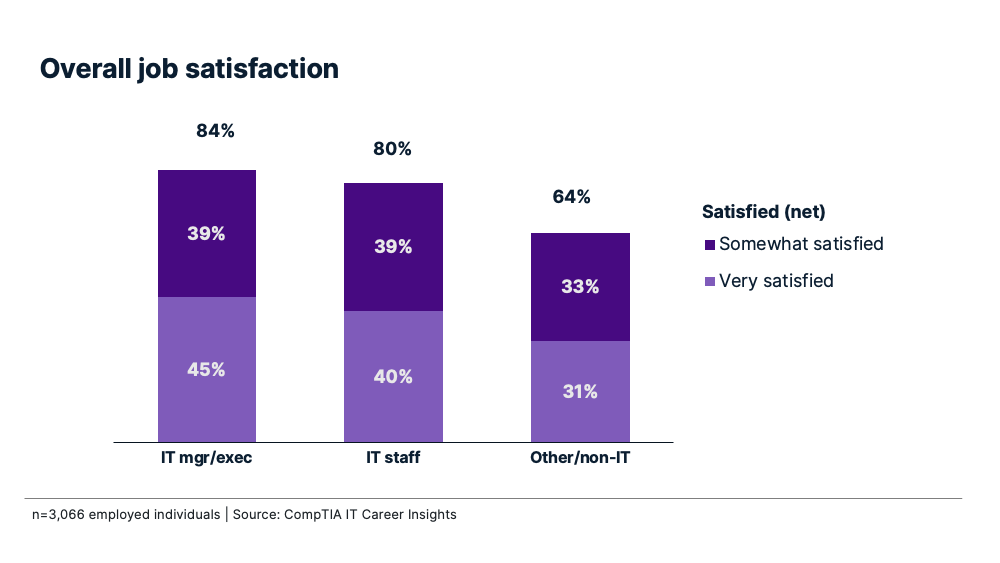
Are satisfied overall with their job (net), rising to 84% among IT managers and 80% of IT staff vs. 64% outside IT
Demand for tech talent continues to grow. Employment in the IT workforce keeps expanding, and employers across industry sectors post hiring opportunities spanning all six tech job families: support, infrastructure, software, data, cybersecurity, and enablement.* For IT professionals, entering the tech field is only the first step. Opportunities for career progression vary, as does access to development support.
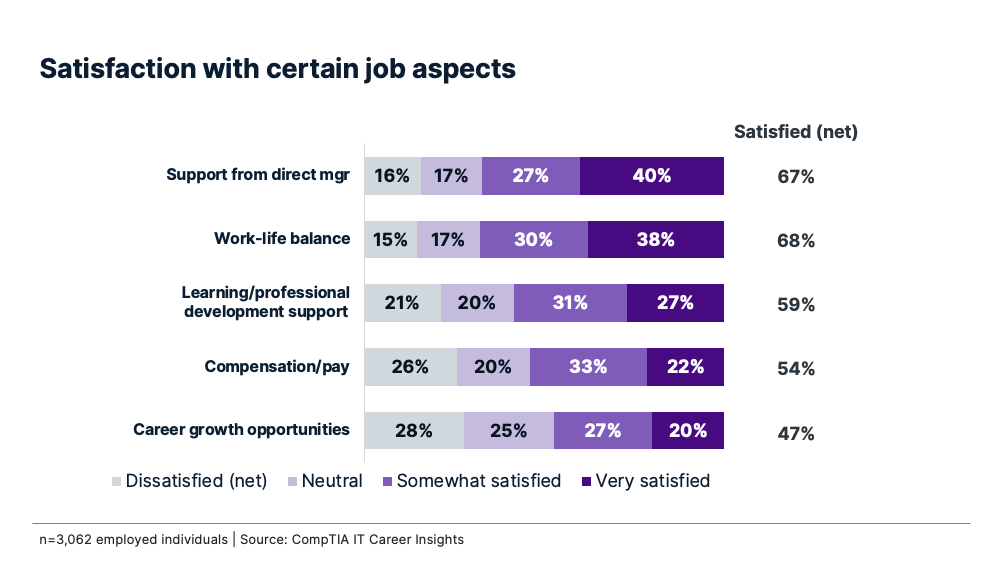
Results from this survey show both sides of this. Three-quarters of IT professionals are relatively satisfied with their jobs overall, while career growth rates are the lowest of the five job aspects measured, and more than a third name a lack of advancement as a concern.
IT professionals especially expect further learning to be part of the year ahead. And AI is reshaping skill needs. Most report that AI already helps them work more efficiently, while the capabilities they want to develop vary by role.
Professionals see credentials as one way to support career advancement. Three-quarters agree CompTIA certifications are valuable for advancing their career, and most holders report a benefit, most commonly a stronger resume or greater confidence. Employer support is not universal, however, as only about 1 in 3 employees indicate their employer pays for certification costs, with support less common at smaller firms.
CompTIA’s IT Career Insights study examines how professionals in 12 countries navigate their careers: what they want to learn, the level of support employers provide, and what credentials deliver.
*The mix of roles varies by employer and sector. See CompTIA’s State of the Tech Workforce and monthly Tech Jobs Report for tech employment and hiring demand trends. Also see the Appendix for more details about CompTIA’s Tech Jobs Taxonomy.
Key takeaways
1. IT workers are satisfied with their jobs, but career growth lags
76%
47%
Are satisfied with career growth opportunities (net), the lowest-rated of five job aspects measured
37%
More than one-third cite lack of career growth as a career path concern
2. Individuals see AI efficiency gains, while skill priorities diverge by job family
55%
Report AI is helping them work more efficiently
57%
Indicate using AI tools effectively is a top skill to develop
68%
Of cybersecurity professionals prioritize AI security/risk management, vs. 32% in data roles
3. Professionals seek a range of learning support
92%
Could use at least one resource to reach their career goals
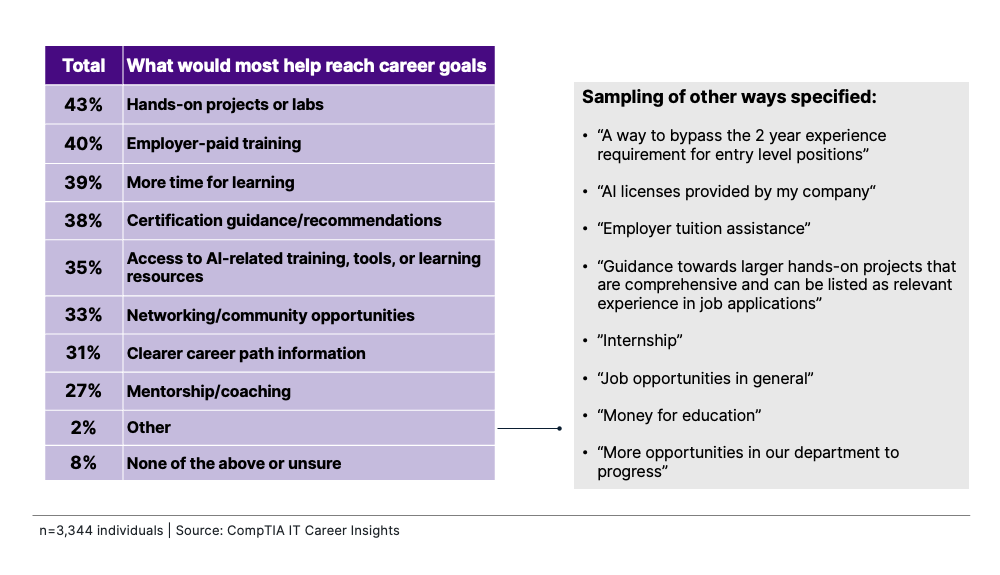
43%
Would find hands-on projects or labs most helpful, followed closely by employer-paid training (40%)
33%
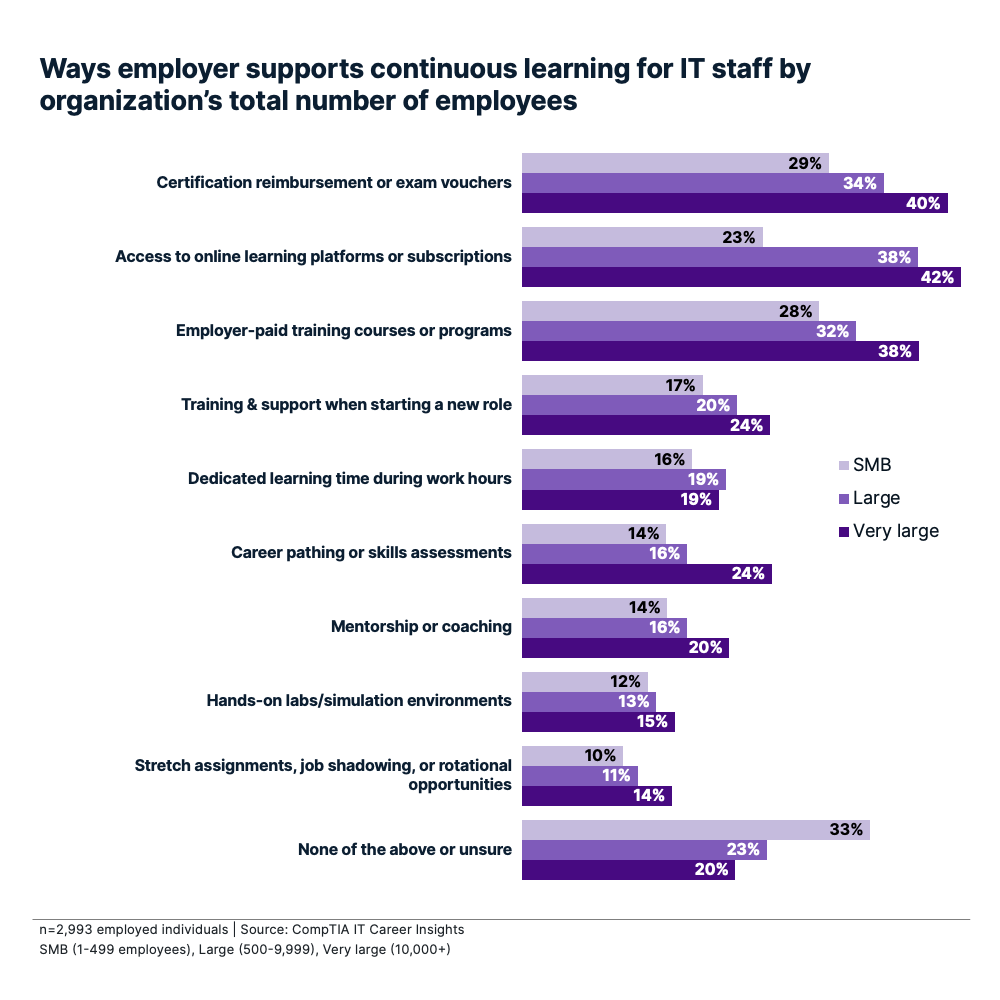
Of SMB employees say their employer doesn’t offer learning support for IT staff or are unsure what’s available
4. Credentials deliver career value, but barriers limit access
81%
Agree CompTIA certifications are relevant to today’s IT roles (net)
84%
Have realized at least one benefit from CompTIA certification, led by a stronger resume and greater confidence
34%
Report that their employer offers certification payment, falling from 40% at very large firms to 29% at SMBs
1. IT workers are satisfied with their jobs, but career growth lags
Among working professionals, most are satisfied overall with their job (76% net), though satisfaction varies across different parts of the job. Job satisfaction is also generally higher among those working in IT, those in more senior roles, and those with more years of IT experience.
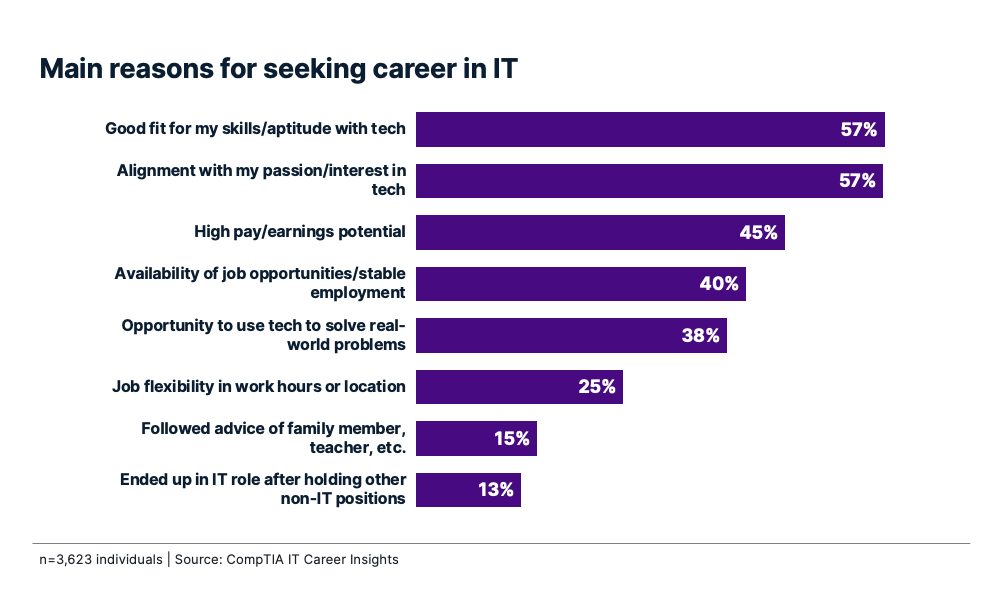
Aptitude and passion for tech are the top drivers for entering the IT field. Beyond those two, motivations vary by market, with pay more prominent in the US and job stability or problem-solving more common elsewhere.
Top reasons by country
| Australia | Brazil | Canada | Germany | |
| #1 | Alignment with passion | Alignment with passion | Alignment with passion | Alignment with passion |
| #2 | Good skills fit | Good skills fit | Good skills fit | Good skills fit |
| #3 | Stable employment | Solve real-world problems | Solve real-world problems | Solve real-world problems |
| India | Ireland | Japan | Mexico | |
| #1 | Alignment with passion | Alignment with passion | Good skills fit | Alignment with passion |
| #2 | Good skills fit | Good skills fit | Alignment with passion | Good skills fit |
| #3 | Stable employment | Stable employment | Solve real-world problems |
Stable employment |
| Saudi Arabia | South Africa | United Kingdon | United States | |
| #1 | Alignment with passion | Alignment with passion | Alignment with passion | Good skills fit |
| #2 | Good skills fit | Good skills fit | Good skills fit | High pay |
| #3 | Solve real-world problems | Solve real-world problems | High pay |
Alignment with passion |
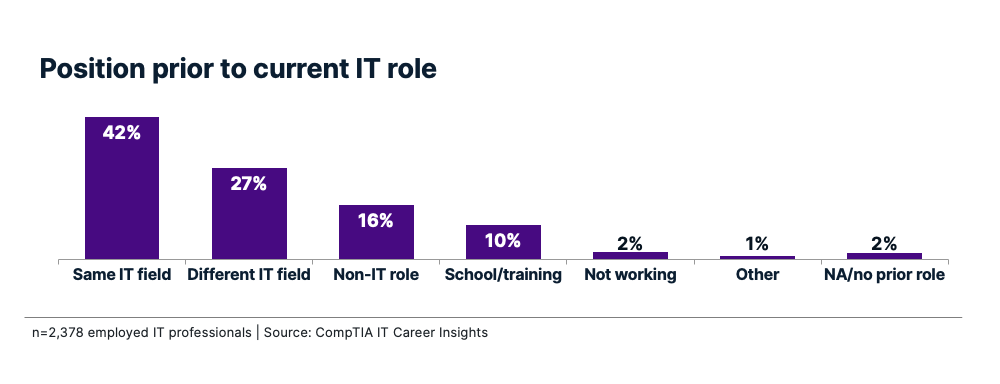
IT career paths involve substantial movement within the field, and credentials at entry vary widely. Prior tech experience is the most common pathway into a current IT role, with nearly 7 in 10 IT workers previously working in the same or a different tech field (69% net). Still, nearly one-third came from non-IT work, school or training, or another prior situation.
The credentials and experience IT workers had when starting their first tech job also varied. Bachelor’s or postgraduate degrees were most common, while notable proportions also reported certification, high school, some college or technical school, and personal tech experience, among others.
Together, these findings highlight the need for workforce and learning strategies that support continued mobility within IT and multiple entry pathways. Furthermore, employers can broaden access to qualified candidates by applying four-year degree and prior tech experience requirements only when truly necessary. They can also build internal pathways that let existing staff move across IT disciplines, increasing the likelihood they stay and grow within the organization.
Top credentials/experience individuals had at first IT job:
43% Bachelor’s or postgraduate degree
29% Certification
27% High school diploma (or GED)/secondary school diploma
27% Some college or technical school without a degree
21% Personal tech experience
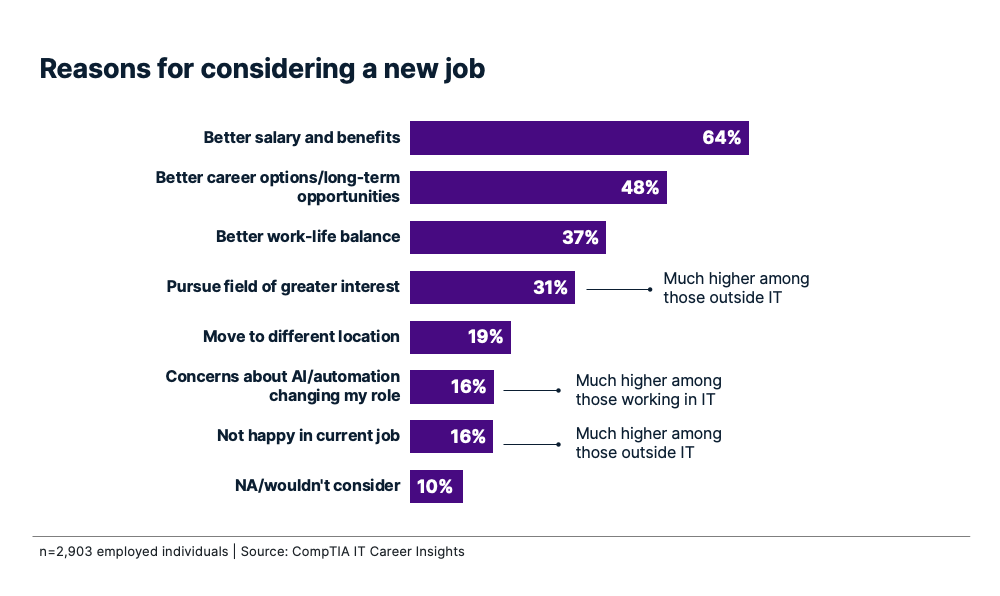
Net 87% of working professionals report at least one concern about their career path. Lack of growth and uncertainty about next steps lead (37% each), but better salary and benefits are the strongest reason to consider a move (64%).
Career path concerns
| Total | IT mgr/exec | IT staff | Other/non-IT | |
| Lack of career growth opportunities | 37% | 32% | 37% | 41% |
| Uncertainty around next steps for career | 37% | 28% | 36% | 44% |
| AI, automation, or other emerging tech | 30% | 32% | 32% | 22% |
| Job stress/lack of work-life balance | 28% | 39% | 27% | 28% |
| Risk of skills becoming obsolete | 27% | 20% | 29% | 24% |
| Risk of job being outsourced or position terminated | 22% | 19% | 24% | 16% |
| Lack of resources to do job effectively | 19% | 26% | 20% | 15% |
| None | 13% | 15% | 13% | 15% |
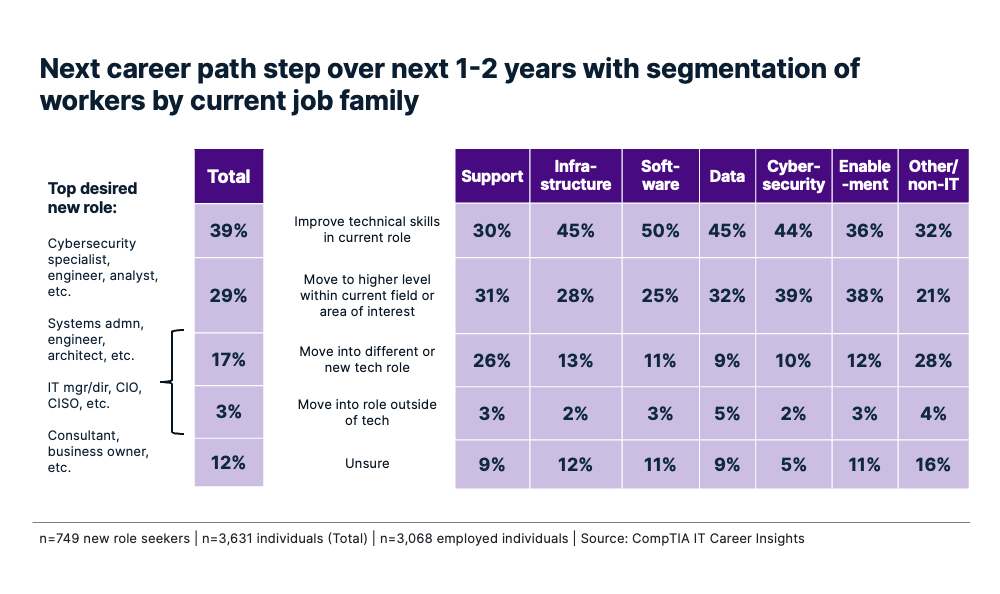
Most professionals plan to develop within their current field. Slightly more than two-thirds intend to do so by strengthening their technical skills or advancing to a higher level (68% net). Among those seeking a new or different role (21% net), interests span several fields, with cybersecurity the most common selection (51%). For employers, this suggests that skills development and clear advancement tracks address what most of the current and potential workforce is seeking.
2. Professionals see efficiency gains from AI, while skill priorities already diverge by job family
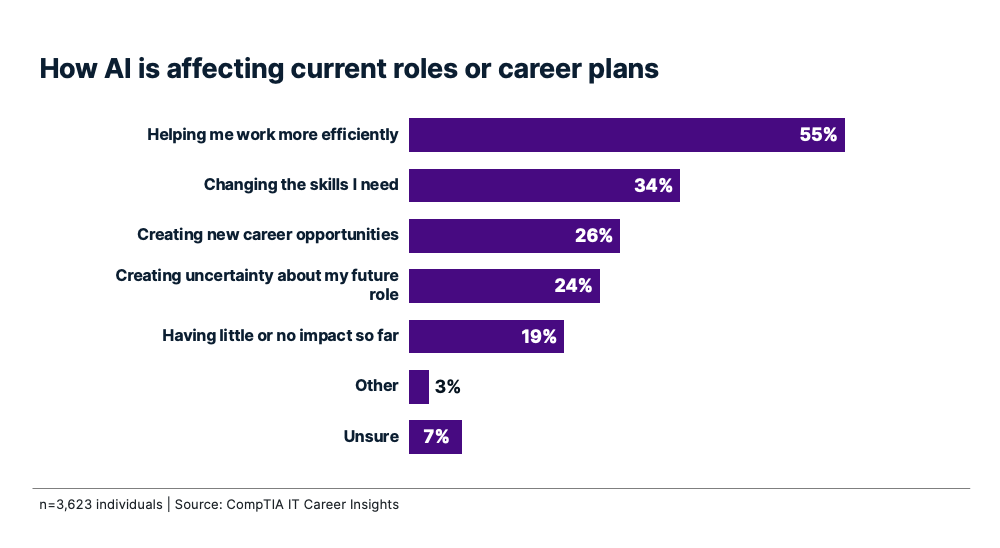
More than half report improved efficiency (55%), about 1 in 3 say AI is changing the skills they need (34%), and 57% prioritize learning to use AI tools effectively. Certified professionals report efficiency gains and new career opportunities at significantly higher rates than non-certified professionals.
Most important AI skills to develop by current job family
| Total | Support | Infrastructure | Software | |
| Using AI tools effectively | 57% | 53% | 61% | 61% |
| AI security/AI risk mgmt | 47% | 42% | 42% | 37% |
| Automating workflows | 46% | 39% | 44% | 47% |
| Identifying AI use cases | 37% | 31% | 38% | 44% |
| Evaluating AI outputs for accuracy/quality | 34% | 23% | 33% | 40% |
| Data analysis/model-related skills | 26% | 21% | 18% | 28% |
| Data | Cybersecurity | Enablement | Other/non-IT | |
| Using AI tools effectively | 59% | 61% | 59% | 55% |
| AI security/AI risk mgmt | 32% | 68% | 55% | 37% |
| Automating workflows | 50% | 55% | 49% | 43% |
| Identifying AI use cases | 43% | 43% | 42% | 36% |
| Evaluating AI outputs for accuracy/quality | 44% | 39% | 41% | 32% |
| Data analysis/model-related skills | 53% | 25% | 29% | 29% |
Continuing with the country-level view, professionals in nearly all the markets covered are most likely to cite efficiency gains from using AI. Notable country differences include higher rates of improved efficiency and new career opportunities in Brazil, changing skill needs in Japan, and uncertainty about future role/career plans in Canada, the UK, and the US.
| AI impact | Australia | Brazil | Canada | Germany | India | Ireland | Japan | Mexico | Saudi Arabia | South Africa | UK | US |
| Helping me work more efficiently | 57% | 75% | 54% | 58% | 55% | 48% | 59% | 63% | 53% | 59% | 53% | 51% |
| Changing the skills I need | 29% | 37% | 38% | 30% | 32% | 29% | 60% | 49% | 25% | 21% | 30% | 35% |
| Creating new career opportunities | 21% | 51% | 25% | 31% | 41% | 24% | 28% | 47% | 32% | 29% | 14% | 24% |
| Creating uncertainty about my future role or career plans | 22% | 15% | 28% | 19% | 18% | 22% | 14% | 12% | 14% | 14% | 27% | 29% |
| Having little or no impact so far | 23% | 12% | 16% | 16% | 17% | 29% | 12% | 12% | 18% | 22% | 26% | 20% |
| Other | 3% | 1% | 5% | 4% | 0% | 1% | 1% | 2% | 0% | 1% | 3% | 3% |
| Unsure | 8% | 1% | 7% | 12% | 8% | 6% | 4% | 2% | 12% | 9% | 7% | 6% |
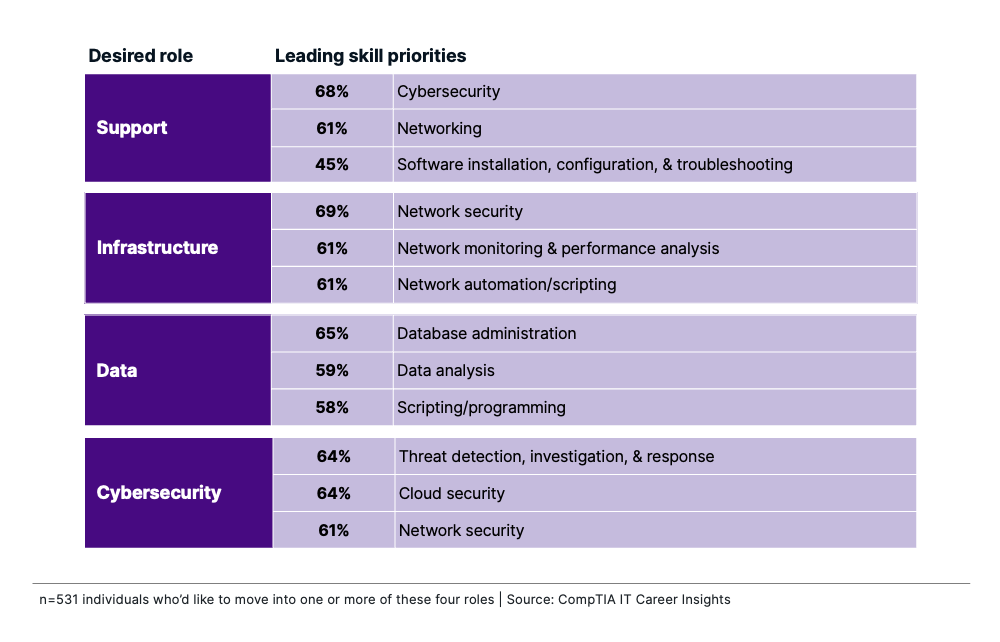
Looking across desired roles, interest in improving security skills extends beyond cybersecurity roles, leading priorities for both support and infrastructure pathways. Role-specific AI skills are more prominent among those pursuing data and cybersecurity.
Security crosses career paths
It is the skill area individuals seeking a role in support (68%) or infrastructure (69%) most want to improve and, naturally, is central to the entire cybersecurity pathway.
AI priorities vary by career path
AI-related skills rank higher among those seeking data (50%) or cybersecurity (59%) roles than for those targeting support (36%) and infrastructure (34%) roles.
3. Professionals seek a range of learning support
Current and aspiring workers point to a range of resources that would most help them reach career goals. Net 92% report they could use at least one.
Employer-provided learning support varies by organization size. Several forms of support for IT employees are more commonly reported at larger organizations. The widest differences appear in access to online learning, certification reimbursement, and employer-paid training. Many other resources, including dedicated learning time and hands-on labs -- both among the top three resources professionals say would help them reach their career goals -- are less commonly offered across company sizes. One-third of SMB employees report that their organization doesn’t offer any continuous learning support for IT staff or are unsure what is available. Even at the largest firms, 1 in 5 says the same, showing room to improve both access to support and awareness of existing resources.
- Employees who are more satisfied with their jobs generally report greater access to learning support, while neutral and dissatisfied employees are more likely to report no support or be unsure what is available.
- Support also varies by industry. Financial/banking/insurance leads across many forms of support, including online learning, certification payment, and career pathing, while government workers report employer-paid training at greater rates.
- Certification payment is reported more often among CompTIA sample vs. third-party panel sample.
Most professionals anticipate needing additional training or education in the next 12 months, including 44% with more definite likelihood. Perhaps as expected, those earlier in their career tend to indicate definitely or probably at higher rates compared to those with more years of IT work experience.
When asked more specifically about the formats they expect to use over the next year, 9 in 10 report at least one. Planned use is greatest for flexible options that can be accessed when needed, and generally lower for formats that require scheduled participation (these findings reflect expected usage, not the relative value of each approach).
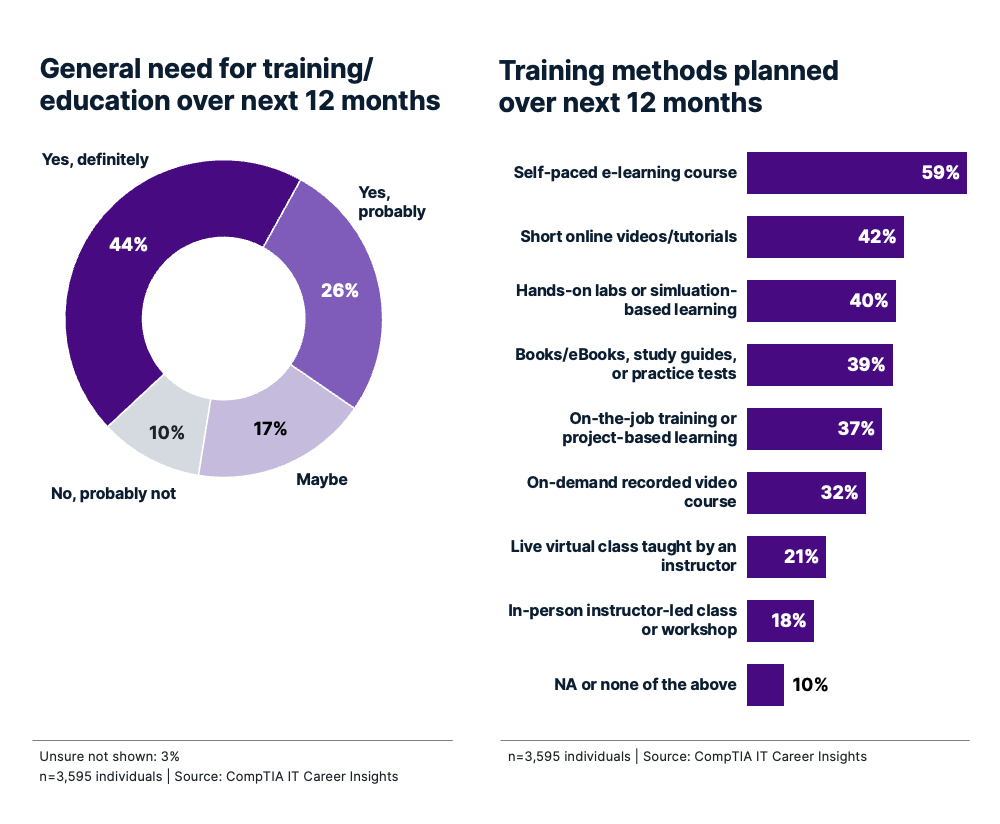
Further, regarding training methods planned by country, self-paced e-learning is the leading planned training method overall and in nearly every country covered. However, preferences for other methods differ by country, reinforcing the need to tailor the mix of training methods offered in each market.
| Training method | Australia | Brazil | Canada | Germany | India | Ireland | Japan | Mexico | Saudi Arabia | South Africa | UK | US |
| Instructor-led live virtual class | 15% | 39% | 17% | 19% | 32% | 19% | 15% | 17% | 18% | 30% | 25% | 20% |
| Instructor-led in-person class | 13% | 28% | 15% | 18% | 28% | 14% | 8% | 10% | 25% | 22% | 18% | 18% |
| On-demand recorded video course | 36% | 59% | 30% | 35% | 33% | 30% | 13% | 48% | 32% | 25% | 31% | 32% |
| Short online videos/tutorials | 43% | 60% | 43% | 45% | 41% | 40% | 20% | 38% | 40% | 42% | 43% | 43% |
| Self-paced e-learning course | 66% | 67% | 60% | 62% | 58% | 63% | 35% | 71% | 56% | 60% | 64% | 59% |
| Hands-on labs or simulation-based learning | 42% | 65% | 46% | 42% | 52% | 40% | 17% | 50% | 33% | 44% | 43% | 37% |
| Books/eBooks, study guides, or practice tests | 45% | 56% | 44% | 42% | 37% | 46% | 30% | 71% | 25% | 37% | 42% | 36% |
| On-the-job training or project-based learning | 37% | 43% | 35% | 39% | 45% | 29% | 10% | 23% | 33% | 38% | 44% | 38% |
| NA or none of the above | 9% | 2% | 10% | 11% | 6% | 10% | 34% | 4% | 10% | 6% | 12% | 9% |
4. Credentials deliver career value, though barriers limit access
About 8 in 10 agree CompTIA certifications are relevant to today’s IT roles (81% net), developed by credible industry experts (80%), helpful in preparing people for real-world roles (78%), trusted by employers (77%), and valuable for advancing their career (75%).
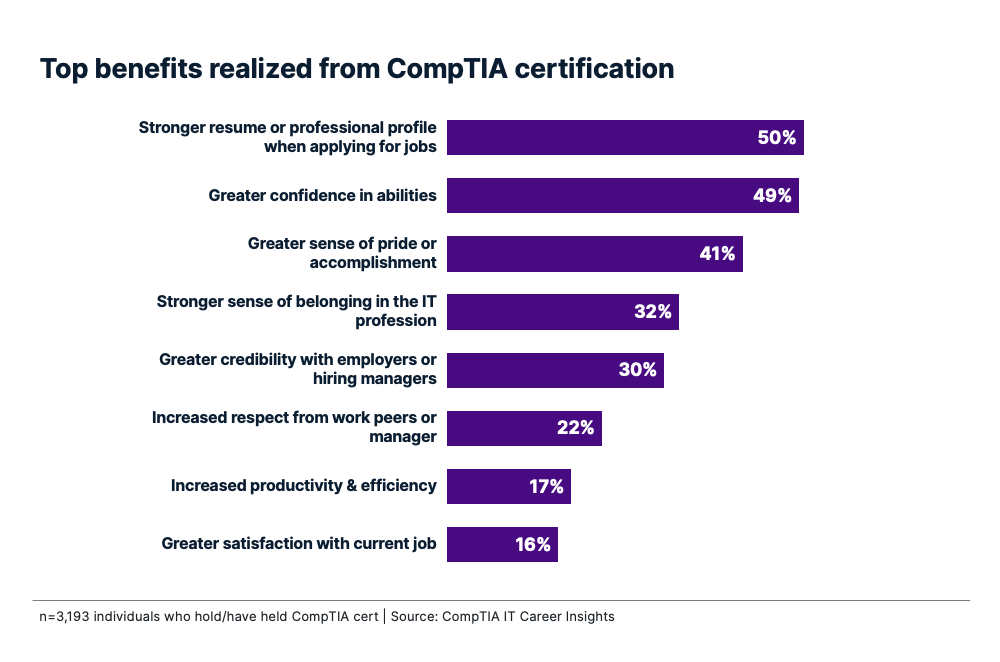
The great majority of CompTIA certified professionals have realized at least one benefit (84% net), led by a stronger resume (50%) and greater confidence (49%).
68% net say certification has already helped their career, including 26% who advanced in their current IT role.
44% paid out of pocket with no reimbursement, vs. 28% whose employer covered the cost.
Across all employed professionals, employer-funded support is limited: about 1 in 3 say their employer offers certification reimbursement or exam vouchers (34%).
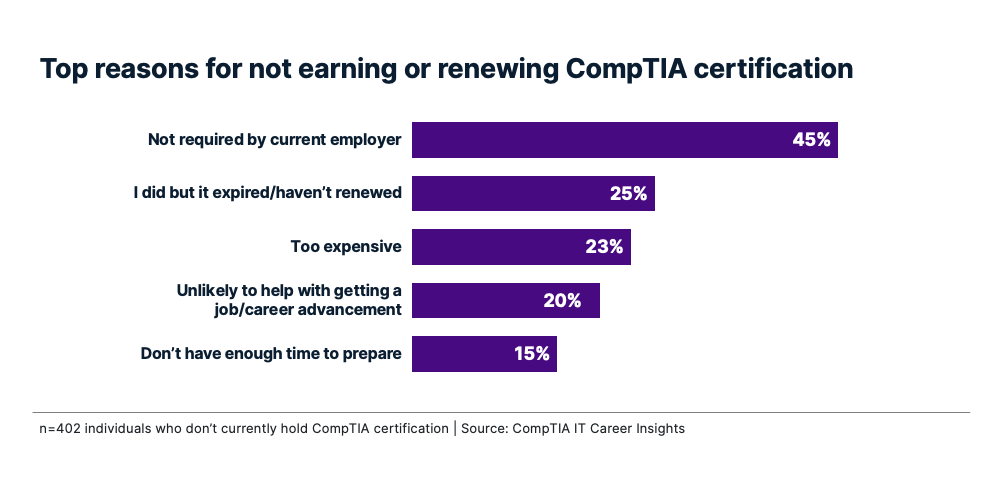
Among the small share without a current CompTIA certification, the top reasons involve employer requirements, expiration/non-renewal, and cost rather than doubts about career value.
“The value of having a CompTIA certification is highly considered when hiring, here in Brazil. However, many companies here do not help to pay for the purchase of the exam.”
The great majority of respondents to this study, by design, hold or have held CompTIA certification. Among the 11% of respondents not currently holding a CompTIA certification, the main reason is that it is not required by an employer, followed by other situations or constraints.
More than 8 in 10 report experiencing at least one of these benefits from earning CompTIA certification (84% net). About half point to a stronger resume (50%) and greater confidence (49%), followed by a sense of pride in achievement (41%).
Benefits are most pronounced among those who keep their certification current: 85% of current holders report at least one benefit, vs. 71% whose certification is no longer current.
Stronger resume value is greater among those newer to their role. Six in 10 with less than two years in their current role report a stronger resume (60%), vs. 37% with 10 years or more, for instance.
Beyond the benefits shown here, nearly 1 in 3 among the smaller subset of those employed at the time of certifying report receiving a pay increase and/or bonus from their employer (29% net).
CompTIA certification supports career progress in different ways. Respondents describe entering IT, changing careers, advancing professionally, and gaining confidence and external validation of their skills.
Sampling of verbatim comments:
| Career entry & career change |
|
“The two certifications I got allowed me to get my first job in tech! A great platform for me, I would recommend it to many people.” |
|
“A very good certification that jump-started my career.” |
|
“These certs helped me go from a low pay average tech role into a career in the medical IT field. I no longer need CompTIA specific certs to do my job, but I've always had a sense of pride in having these certs.” |
|
“I love CompTIA thanks for helping me switch my career to tech” |
|
“CompTIA paved the way for me to get my first job” |
| Advancement & opportunity |
|
“CompTIA Certs have opened many doors during my 30 year IT Tech career. Made the difference when other job candidates are more or less equal to me!” |
|
“The certifications are critical to advance in this ever-changing tech environment” |
|
“They are really very good, and I recommend them to any professional who wants to evolve in the technology area and in their career.” |
|
“CompTIA certification have been very valuable for my career advancement.” |
|
“CompTIA certifications provide great value for career growth and upskilling” |
| Confidence & skill validation/credibility |
|
“CompTIA certifications helped me boost my confidence in the tech field which helped me land my first job.” |
|
“CompTIA certifications validate your skills, increase employer trust, improve job opportunities, and support long-term career growth.” |
|
“CompTIA are a respected Certification with great recognition within the industry.” |
|
“I think CompTIA does a great job of providing certification exams that really test your skills” |
|
“I appreciate CompTIA's commitment to providing high-quality certifications and training that are aligned with current industry needs. The learning resources, certification paths, and focus on practical skills have been valuable for building technical knowledge and supporting professional growth.” |
For additional details found in the appendix, download the full report.
Methodology
CompTIA’s IT Career Insights study was conducted via a quantitative survey fielded online during July – August, 2026. A total of 3,631 CompTIA certification alumni (n=3,122) and other IT professionals acquired through a third-party panel (n=509 in the US) completed the survey. The overall margin of sampling error at 95% confidence is +/-1.6 percentage points. Subsets of data and segmentations will have higher estimated sampling error rates.
The study covered 12 countries: Australia (n=208), Brazil (n=178), Canada (n=272), Germany (n=272), India (n=131), Ireland (n=147), Japan (n=185), Mexico (n=49), Saudi Arabia (n=73), South Africa (n=287), the UK (n=229), and the US (n=1,600). Smaller country bases are directional. Consider that the majority of respondents are currently CompTIA certified.
While non-sampling error cannot be accurately calculated, precautionary steps were taken in all phases of the survey design, collection, and processing of the data to minimize its influence. Research has shown that cultural differences exist and can affect responses to certain question types, such as 5-point satisfaction ratings.
CompTIA, Inc. is a member of the market research industry’s Insights Association and adheres to its internationally respected Code of Standards. Any questions regarding the study should be directed to CompTIA Research and Market Intelligence staff at research@comptia.org.
About CompTIA
CompTIA, Inc. is the leading global provider of vendor-neutral training and certification products in the information technology (IT) space. More than four million CompTIA certifications have been awarded to current and aspiring technology workers, business professionals, government and military personnel, career changers, students and others. Working in partnership with thousands of academic institutions, governments, training providers and workforce development organizations, CompTIA uses best-in-class learning solutions, industry-recognized certifications and career resources to help job seekers reach their full potential and employers develop skilled technical talent.
About CompTIA Research
Seth Robinson is the vice president of research at CompTIA, overseeing market research and providing insights on workforce trends and technology adoption.
Amy Carrado is the senior director of workforce and internal research at CompTIA, creating data definitions for the tech workforce and driving analysis of IT careers.
Anna Matthai is the director of research and market intelligence at CompTIA, managing survey operations and building synopses of tech workforce dynamics.