Very familiar or moderately familiar with AI in general
Summary
Approaching the four-year anniversary of generative AI’s debut, the hype cycle remains vibrant, although some signs of disillusionment are emerging. Along with imprecise productivity gains and rising costs, the question of workforce skill is one that many organizations are chasing. CompTIA’s inaugural AI Skills Tracker establishes a baseline for understanding skill-building trends at an individual level. The data shows that familiarity levels and positive impact are highest among those actively building skills (in other words, the most curious). Training formats to date have focused on informal options, but the demands for better security, clear use cases, and hands-on learning will drive more robust offerings, with proof of AI fluency becoming a valued asset for career growth.
Key Stats
60%
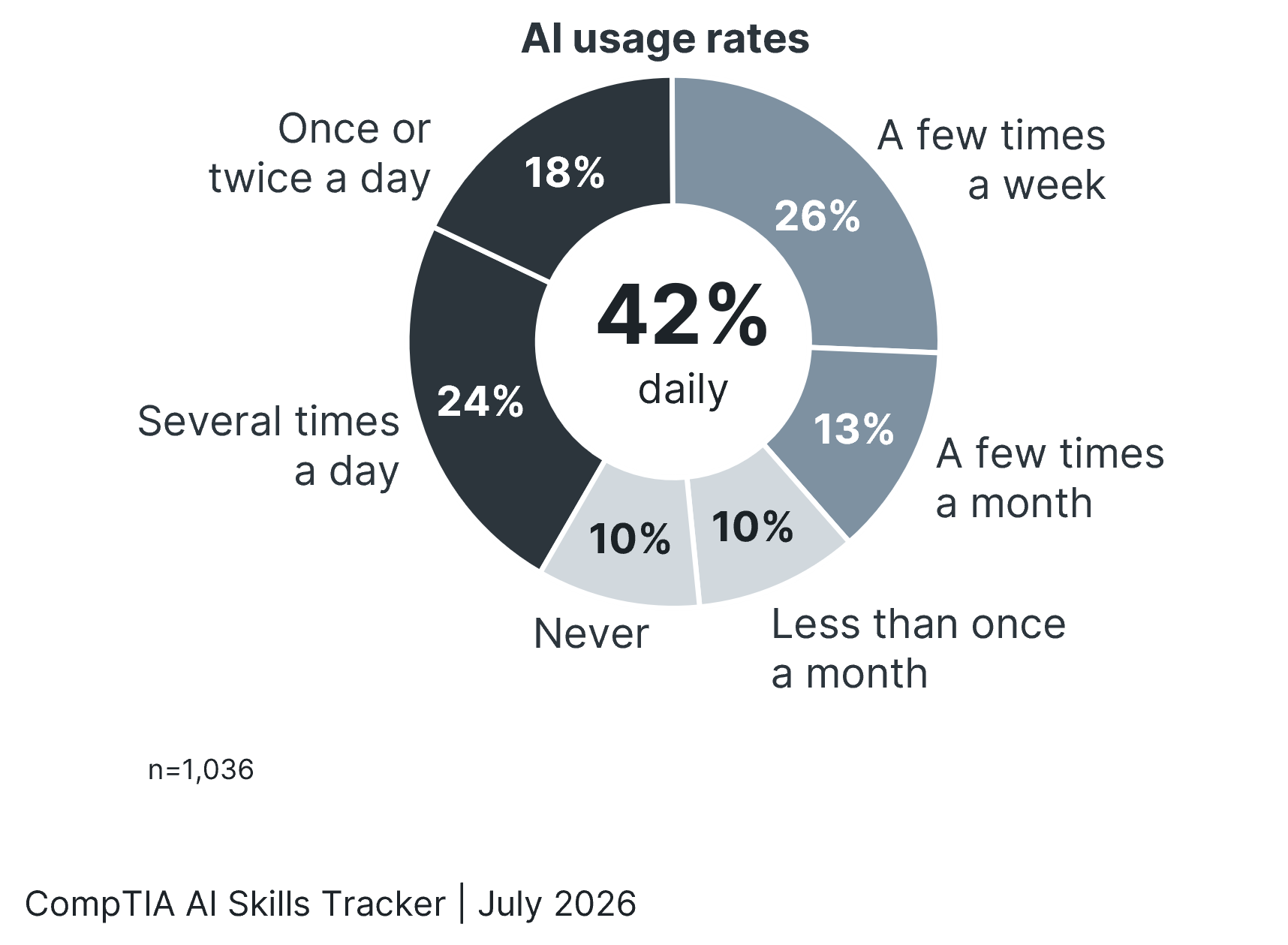
42%
Use AI on a daily basis
71%
AI has had a positive impact at work
68%
AI skills are important to career
52%
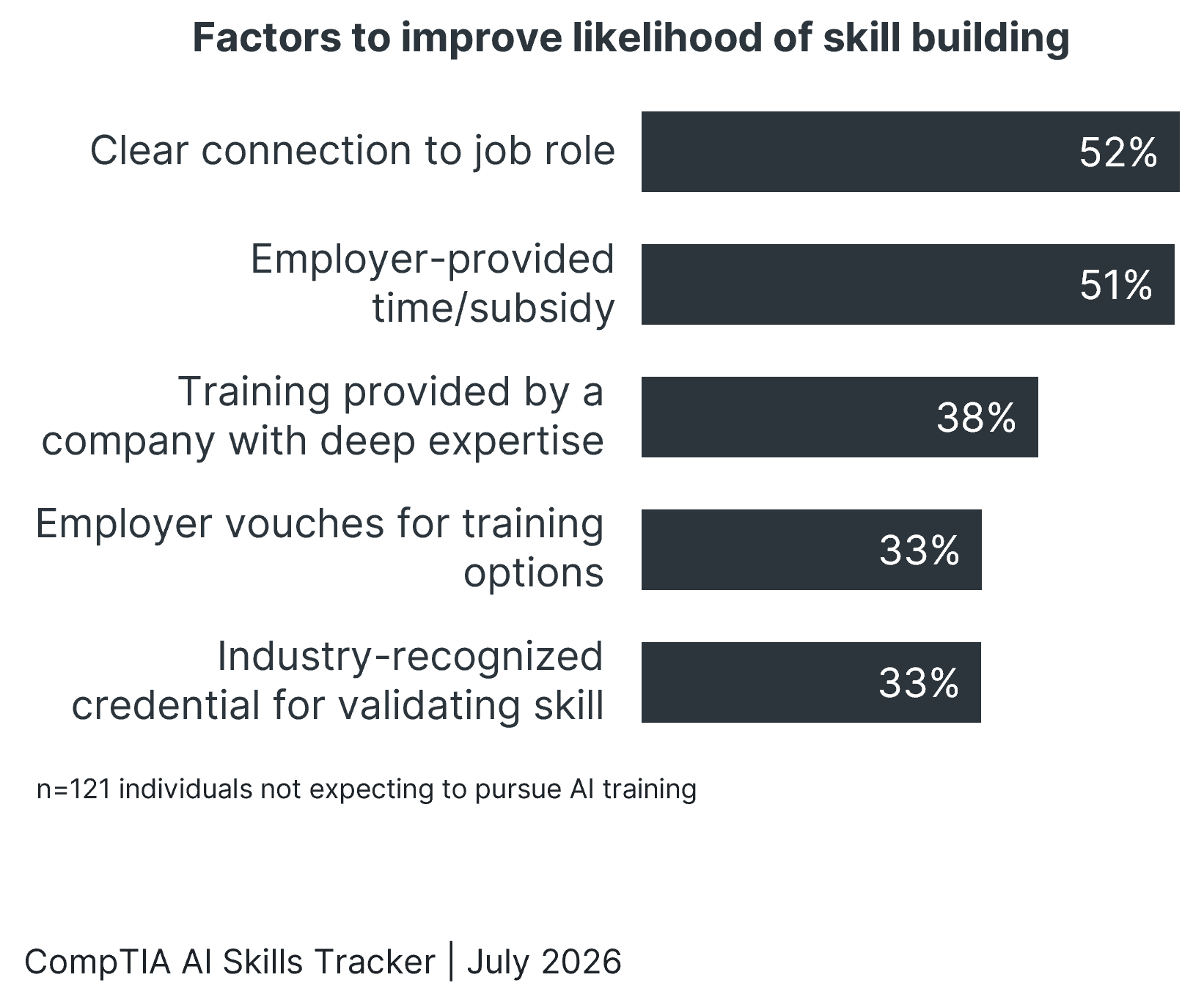
More likely to seek AI training if they see a clear connection to job role
1. Familiarity levels
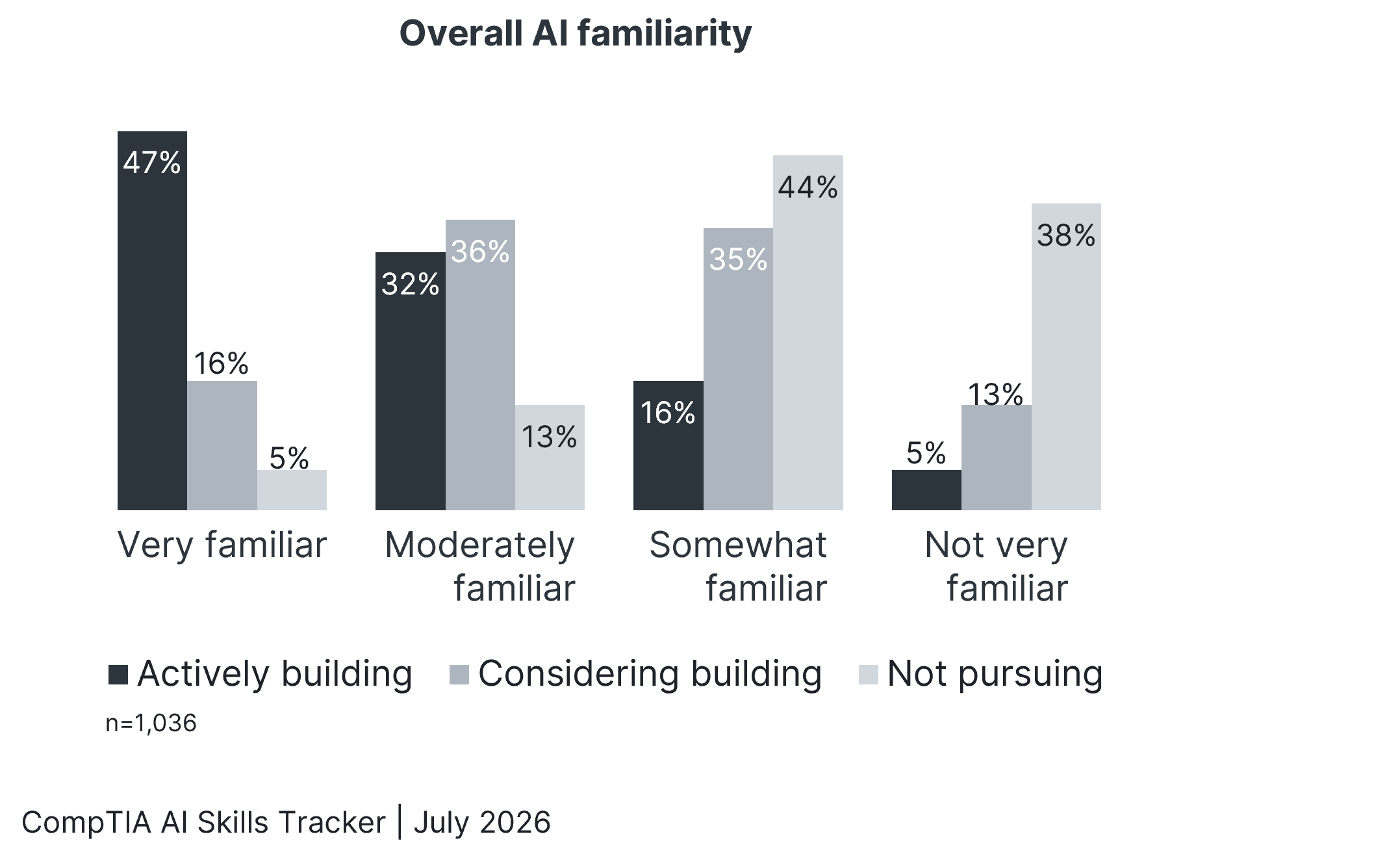
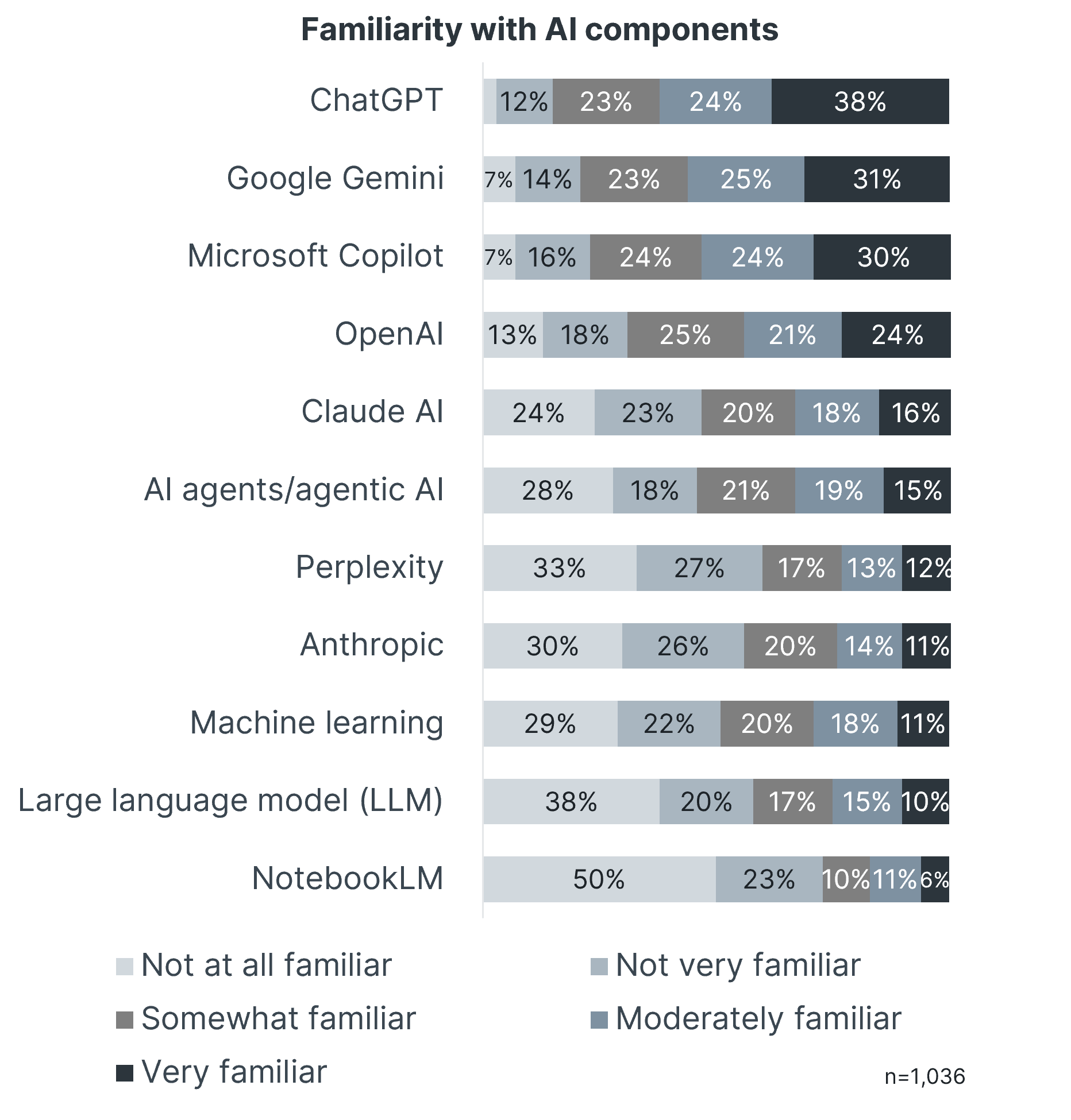
Familiarity levels provide the first step in understanding the degree of AI acumen. Overall, 29% of individuals surveyed state they are very familiar with AI. This is largely driven by 47% of individuals who are actively pursuing new skills, indicating that proactive curiosity is driving a greater understanding of AI’s complexity. Further emphasizing the low appreciation of complexity, there is significant drop-off in specific tool familiarity after the top three, which were either first-to-market or are associated with strong existing brands.
2. Usage patterns
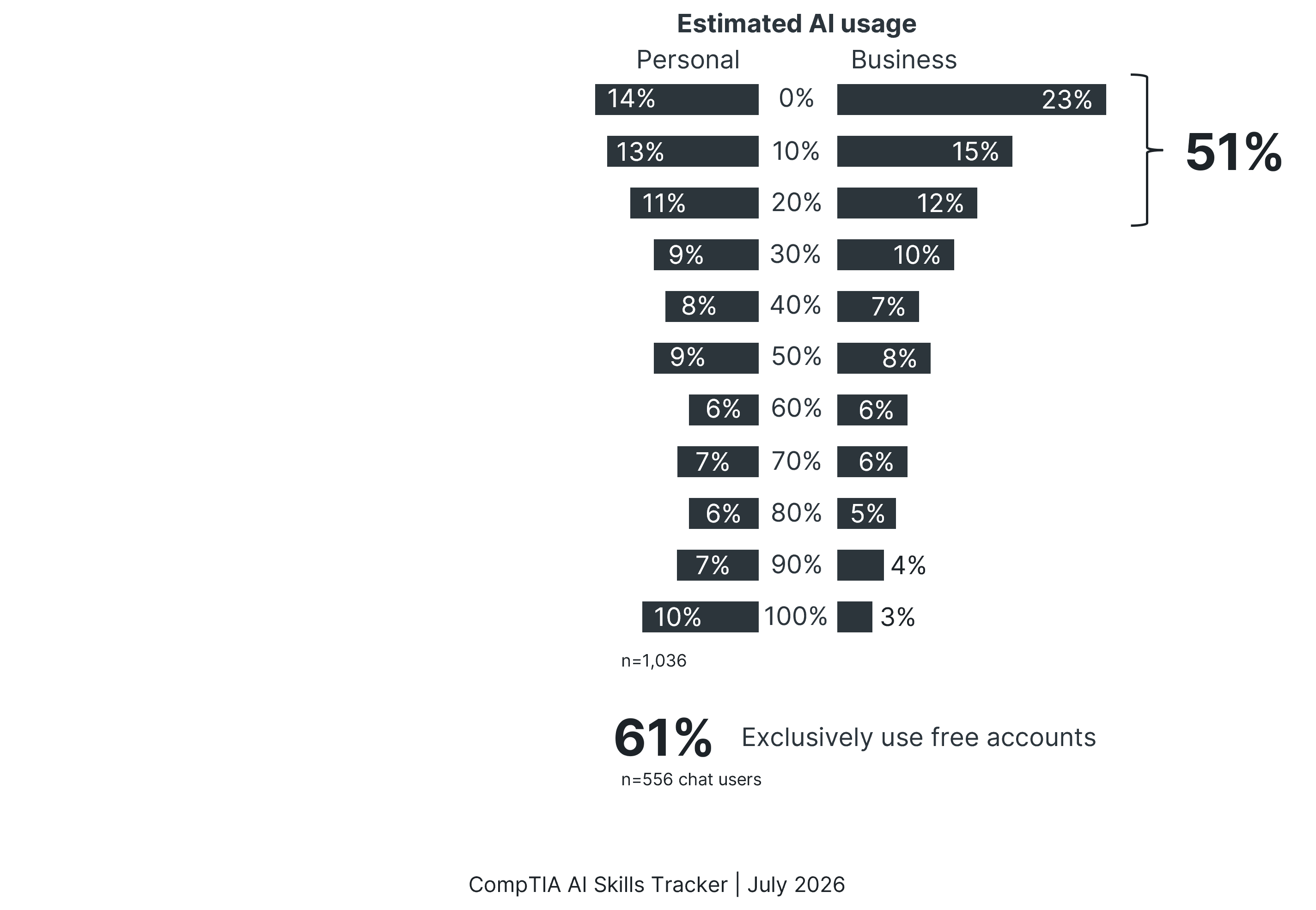
AI usage patterns are fairly robust, with 80% of individuals claiming to use AI multiple times a month or more. However, this usage is tilted toward consumer activity. More than half the sample estimates their business usage to account for 20% or less of overall AI usage, and more than 6 in 10 individuals are exclusively using free accounts, suggesting either no connection or unauthorized connection to corporate data and systems.
3. Workplace impact
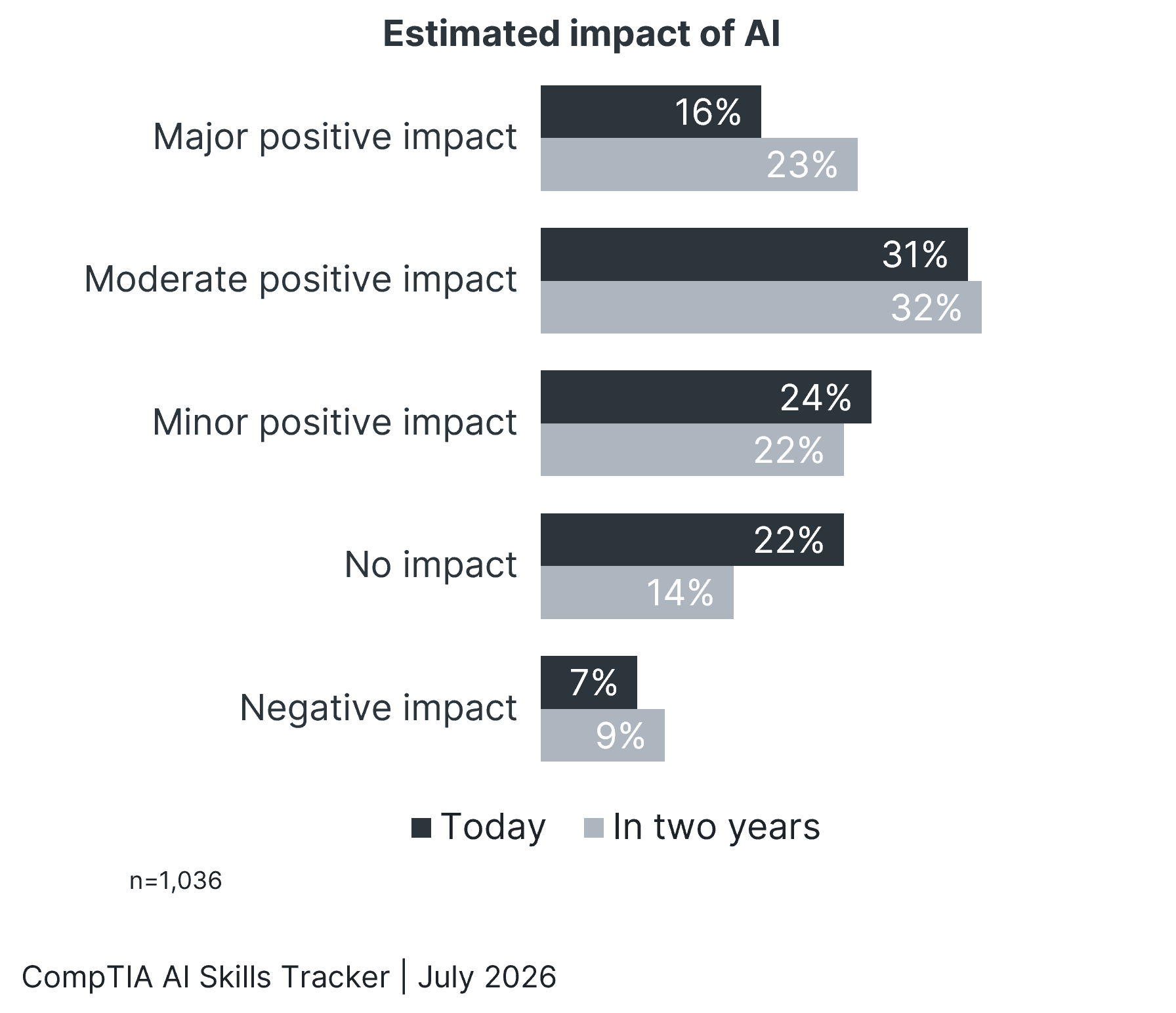
After more than three years of market exposure, few individuals claim a major positive impact from AI in their work. More telling is that there is not a substantial jump in estimated impact two years into the future. Employees need more specific job-related use cases to drive greater impact.
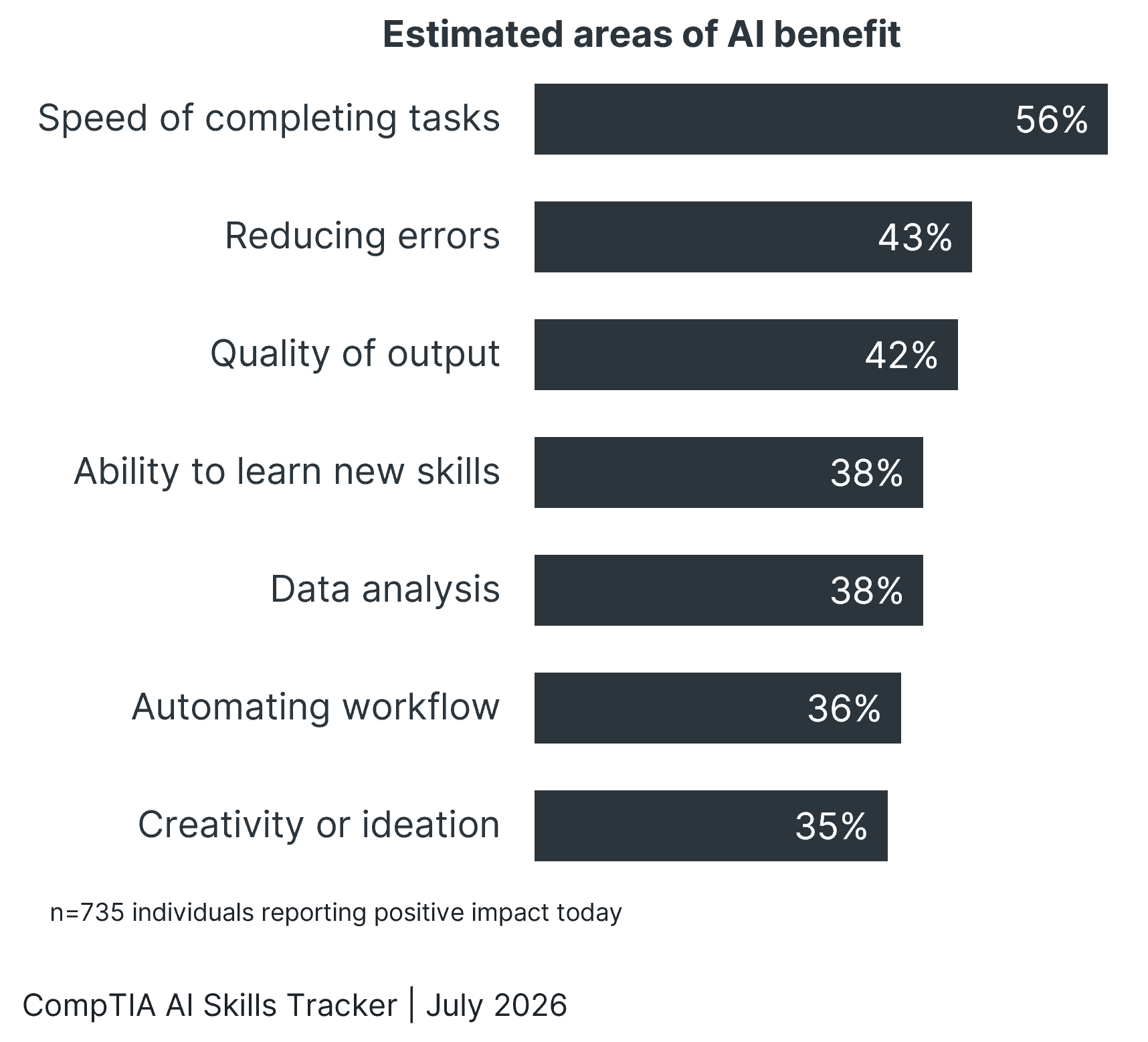
While over half the sample indicates that AI helps them speed up tasks, this alone could have a negative productivity impact if employees are not properly validating output or adding other quality checks within workflow.
4. Skill assessment
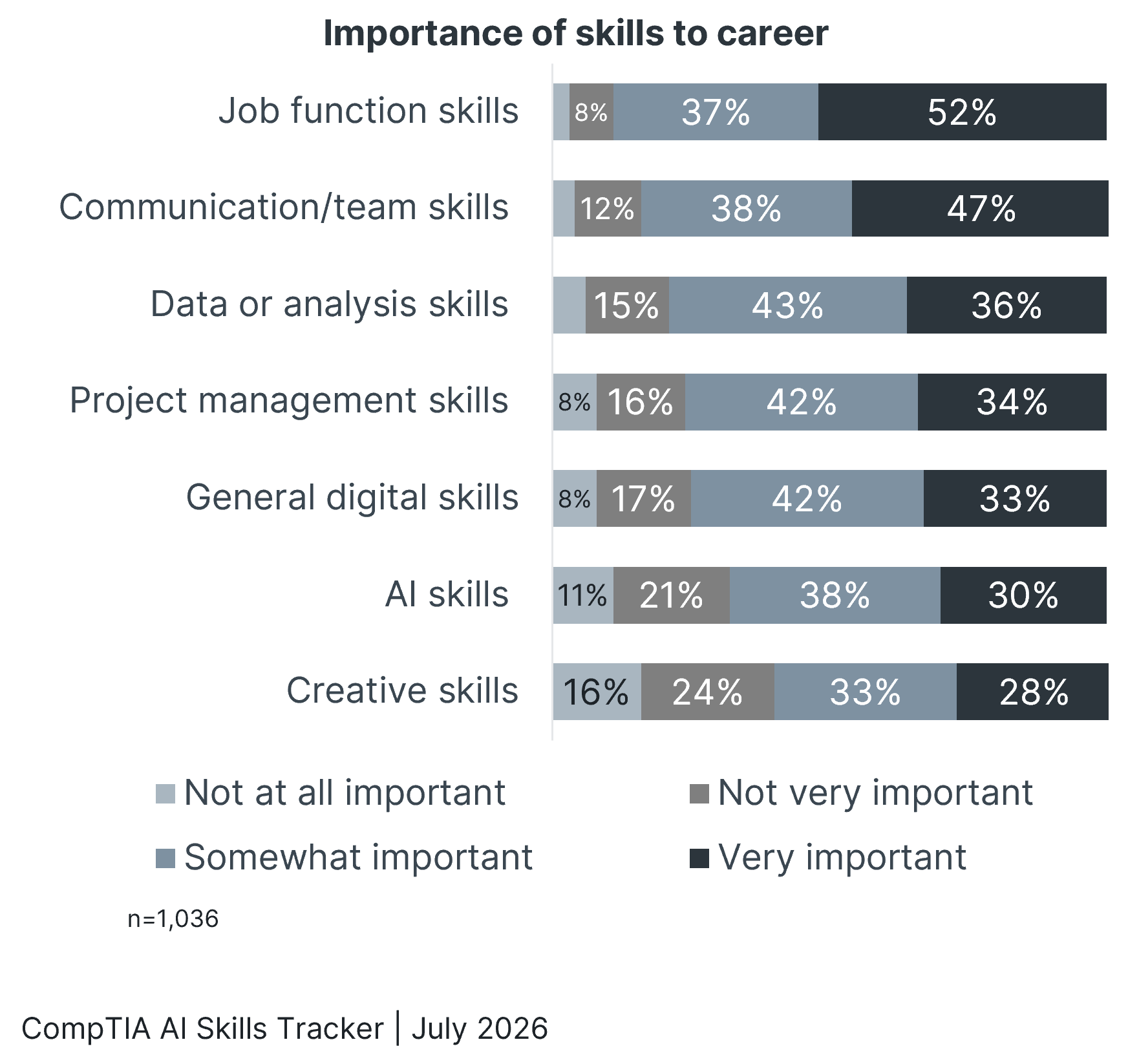
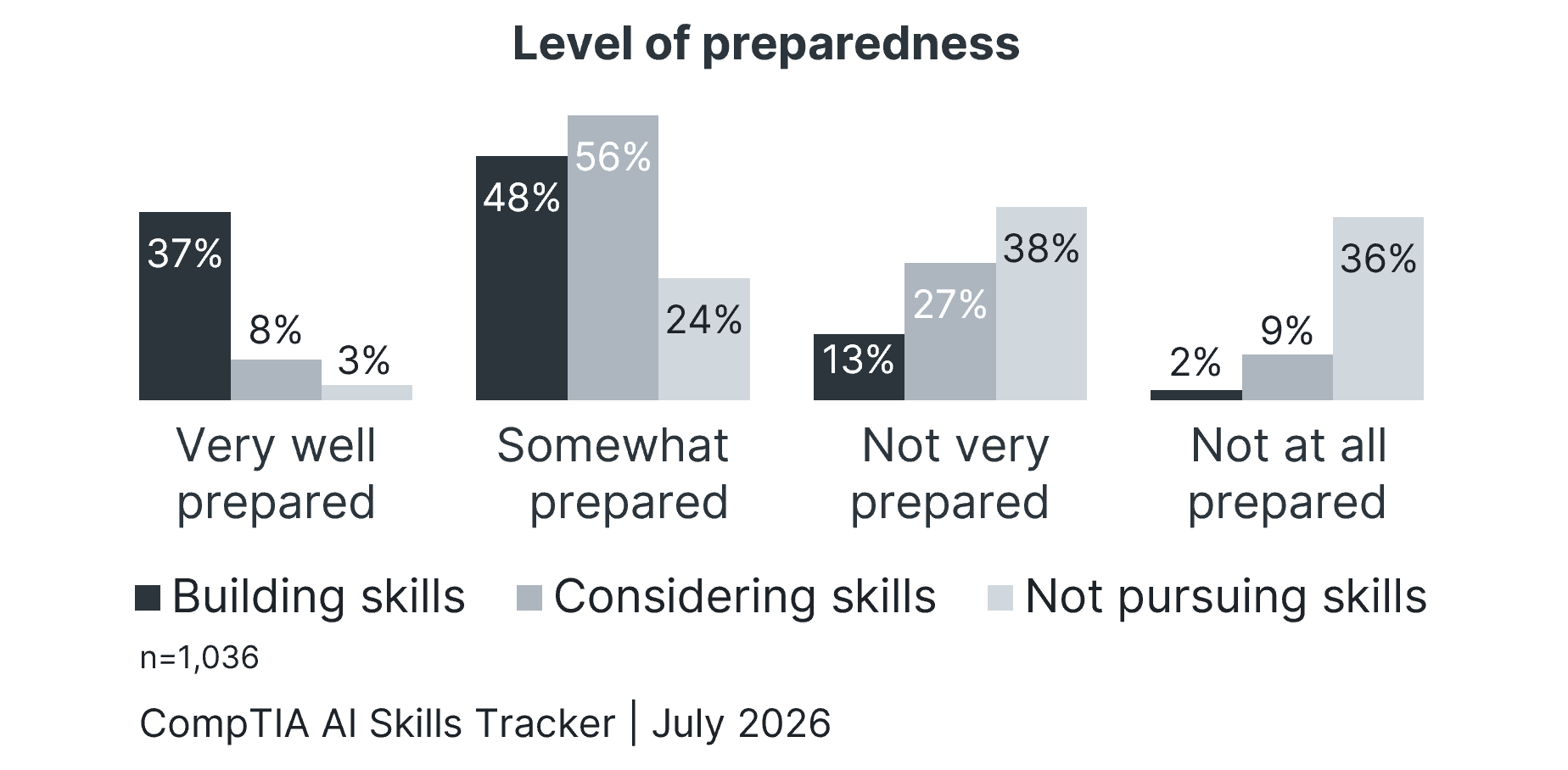
Overall, AI skills still rank below many existing skill sets in terms of importance. Those individuals actively building skills are the most well prepared to use AI, but there is not a strong desire for advanced AI usage over the next 12 months.
5. Skill building
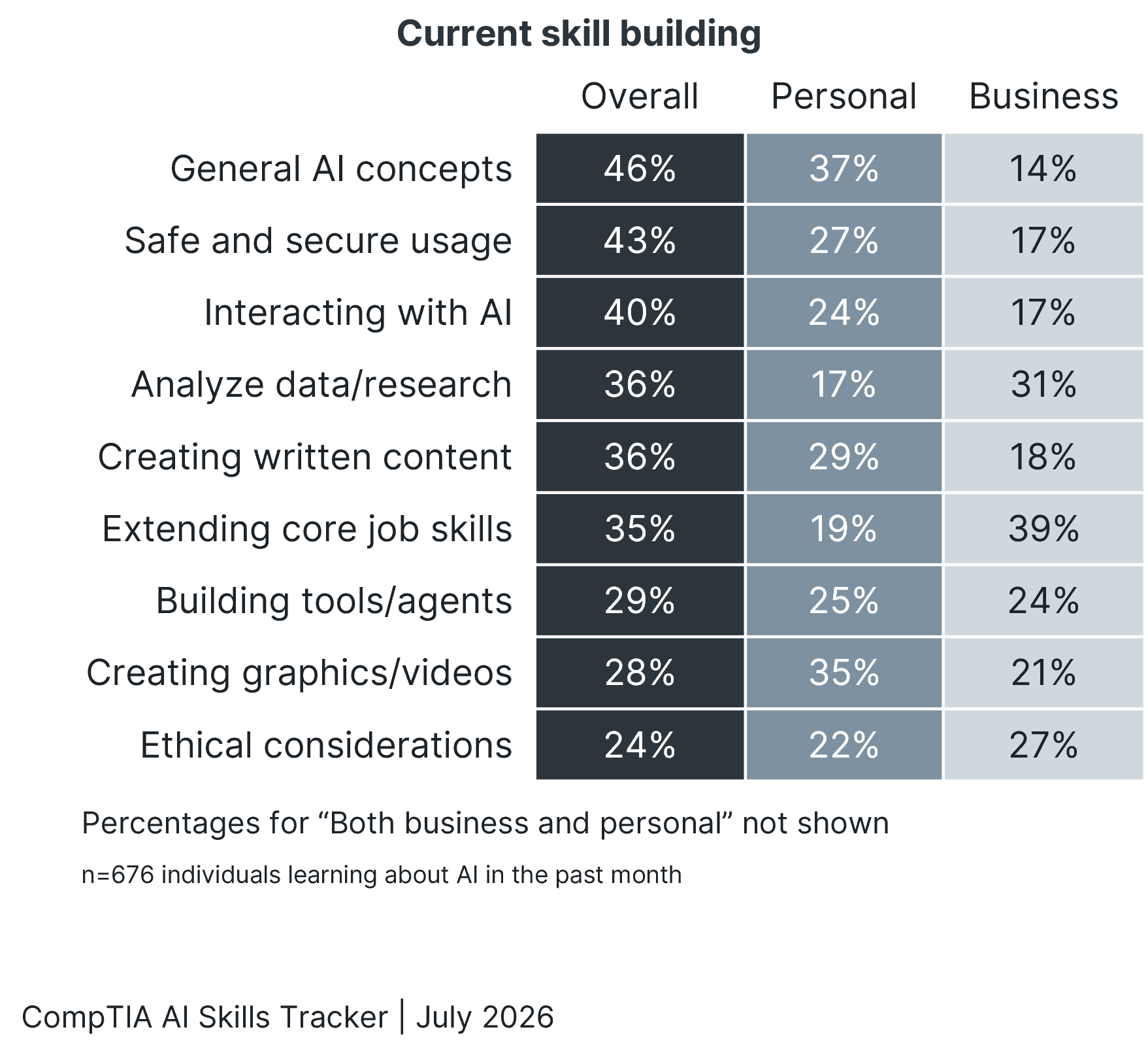
To date, AI learning has focused on general concepts, safe usage, and interactions. Among those individuals who have pursued learning, the mix of personal knowledge and business knowledge indicates a lack of clarity around how AI can be applied in work settings.
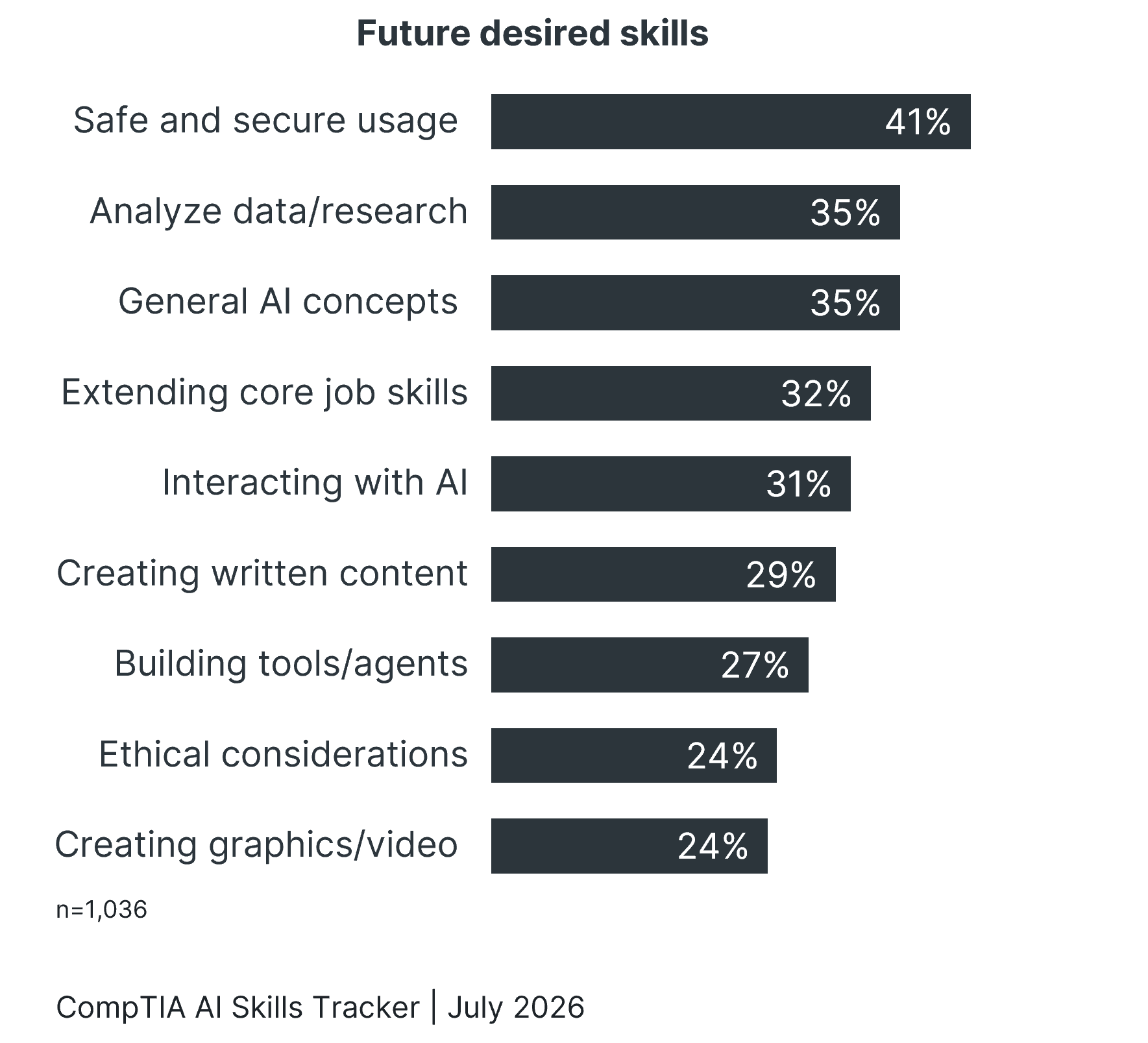
Looking forward, two areas stand out as learning targets: security and data. Depending on job role, the overlap of AI with these other skill sets will vary as novices leverage AI as an add-on and experienced professionals use AI as an extension.
6. Training pathways
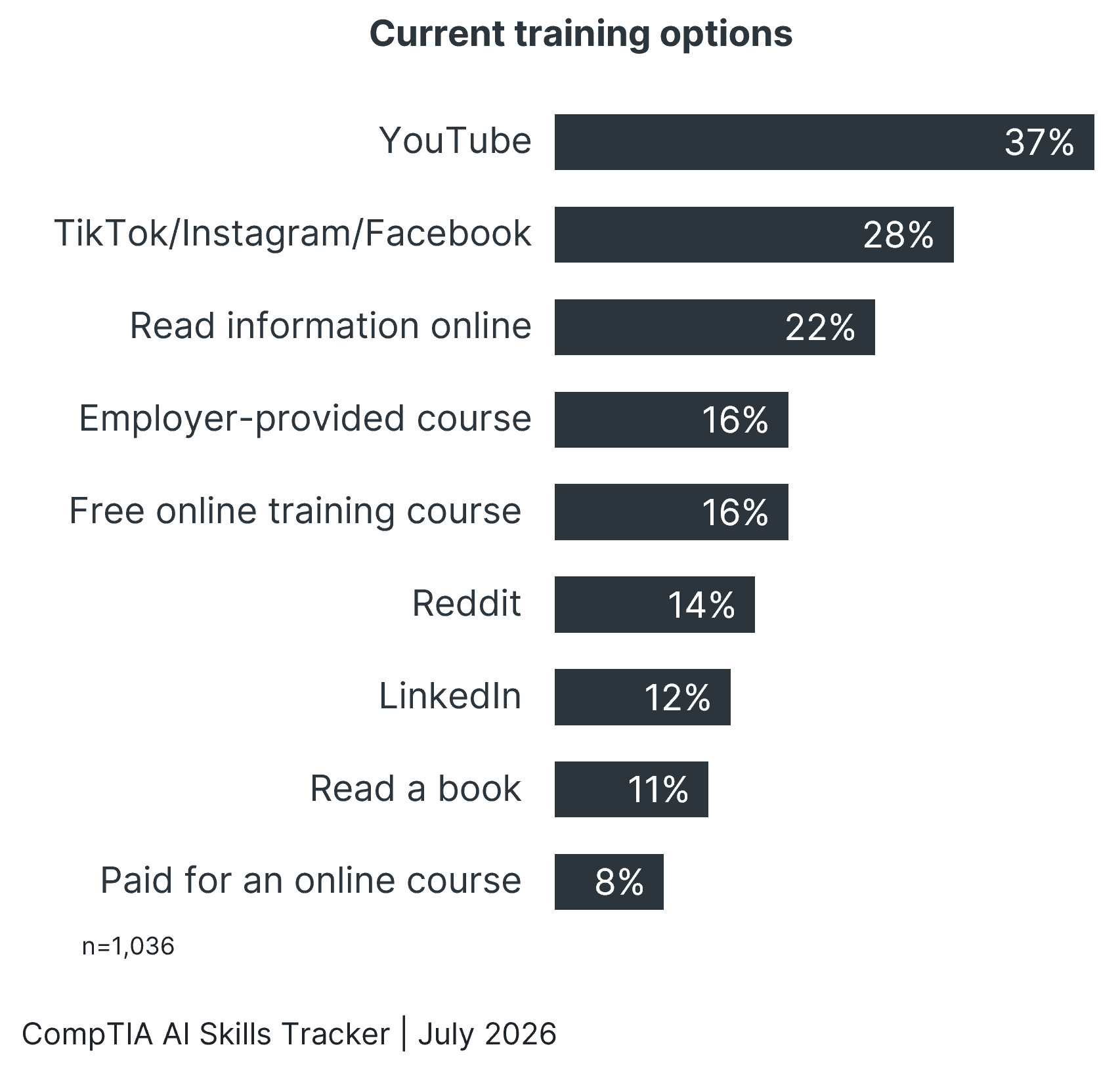
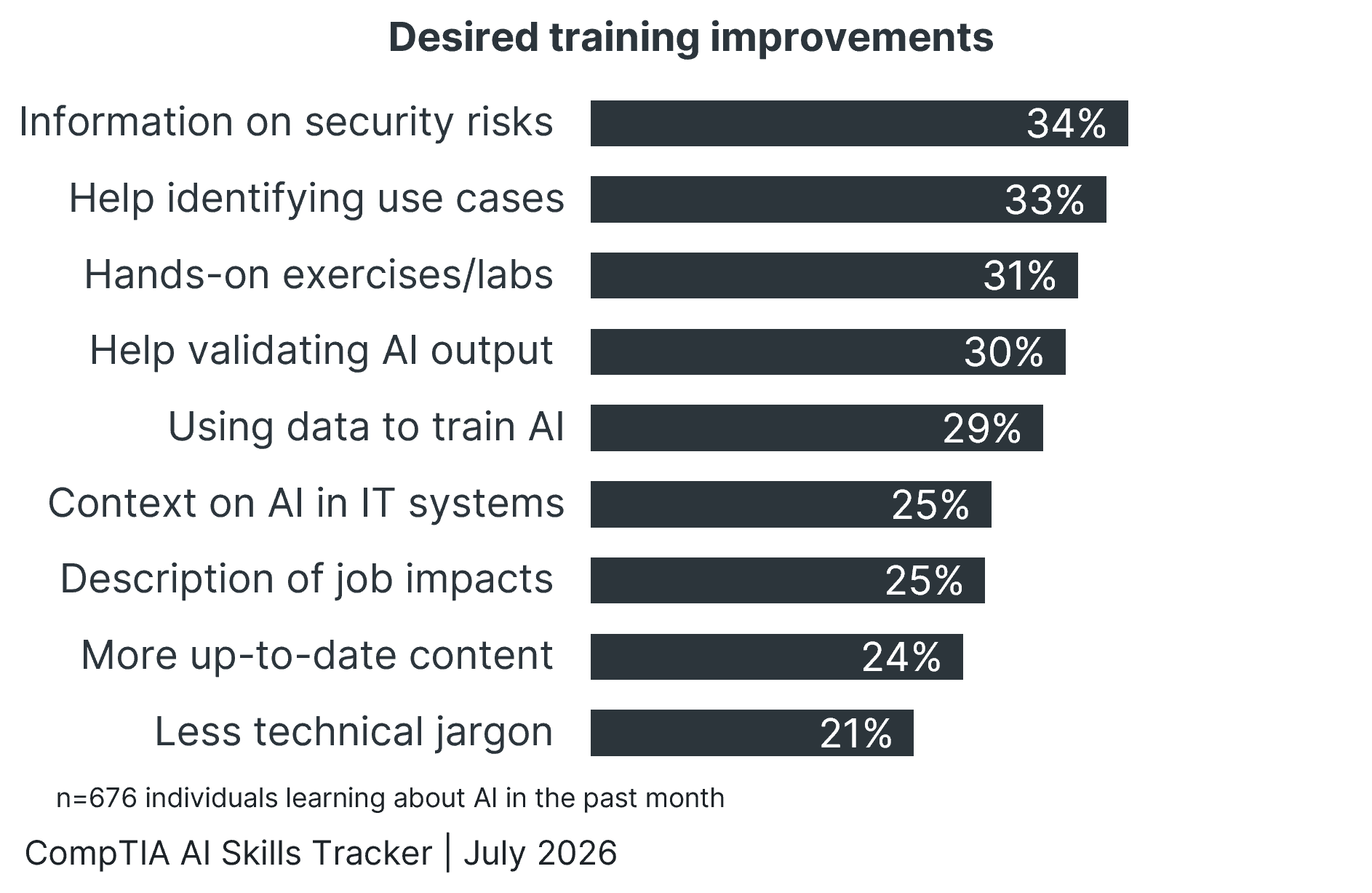
Individuals who have already pursued training have mostly used free options with no validation mechanisms. Given the desired improvements that provide more focus and depth, formats for future training will need to be more robust.
7. Challenges
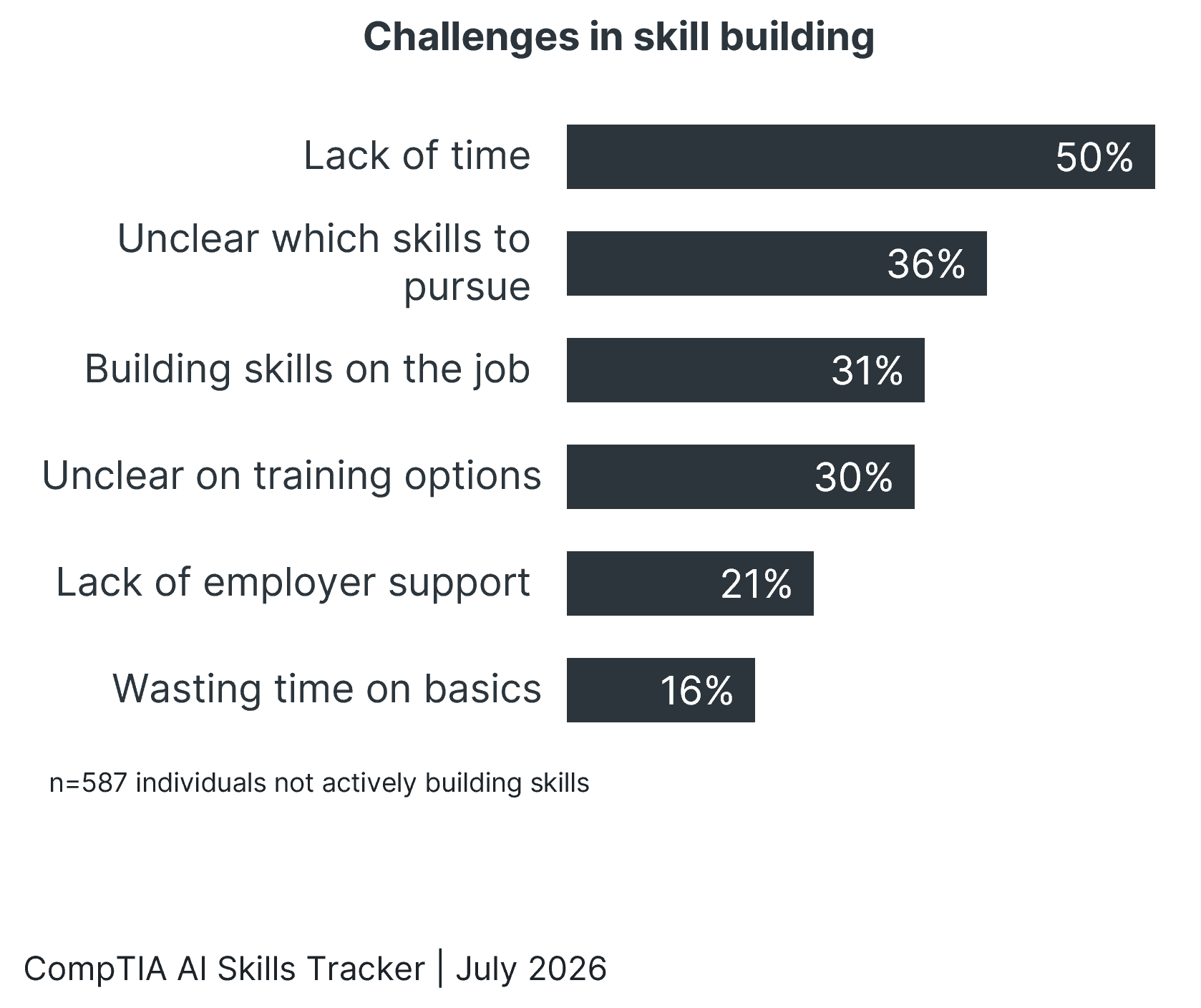
The lack of time for training is a perennial concern that lies between personal choice and employer support. More interesting is the second hurdle: lack of clarity around the skills that matter. The rapid pace of AI innovation and the ongoing exploration of corporate integration make it difficult to determine which skills are needed for long-term success.
Connection to individual job roles is tightly tied to definition of modified workflow. Until organizations build stable new processes with AI integration, the use of AI for daily tasks will be a moving target. The low rating for industry-recognized credentials is also dependent on employer action, specifically the mapping of credentials to a taxonomy of skills.
Methodology
CompTIA’s AI Skills Tracker was conducted via a quantitative survey fielded online during June 2026. A total of 1,036 business and technology professionals completed the survey, yielding an overall margin of sampling error proxy at 95% confidence of +/- 3.1 percentage points. Subsets of the data and segmentations will have higher estimated sampling error rates.
As with any survey, sampling error is present and will be higher for subsegments of the dataset. While non-sampling error cannot be accurately calculated, precautionary steps were taken in all phases of the survey design, collection and processing of the data to minimize its influence.
CompTIA, Inc. is a member of the market research industry’s Insights Association and adheres to its internationally respected Code of Standards. Any questions regarding the study should be directed to CompTIA Research and Market Intelligence staff at research@comptia.org.
About CompTIA
CompTIA, Inc. is the leading global provider of vendor-neutral training and certification products in the information technology (IT) space. More than four million CompTIA certifications have been awarded to current and aspiring technology workers, business professionals, government and military personnel, career changers, students and others. Working in partnership with thousands of academic institutions, governments, training providers and workforce development organizations, CompTIA uses best-in-class learning solutions, industry-recognized certifications and career resources to help job seekers reach their full potential and employers develop skilled technical talent.
About CompTIA research
Seth Robinson is the vice president of research at CompTIA, overseeing market research and providing insights on workforce trends and technology adoption.
Amy Carrado is the senior director of workforce and internal research at CompTIA, creating data definitions for the tech workforce and driving analysis of tech careers.
Anna Matthai is the director of research and market intelligence at CompTIA, managing survey operations and building synopses of tech workforce dynamics.